More Than 100 Literary Workers Are Building Their Own PEN Center
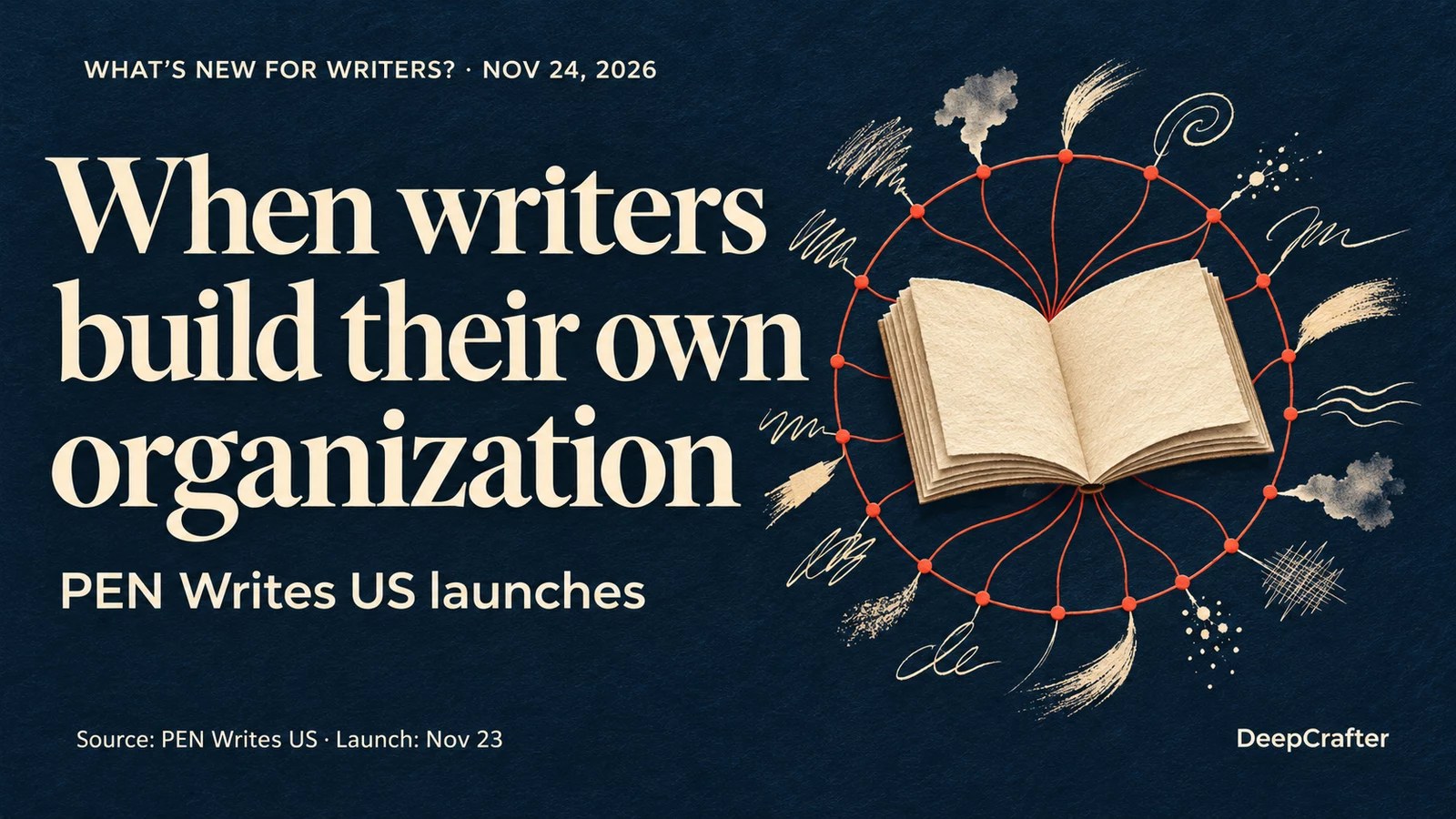
PEN Writes US has launched as an aspiring center. Its concrete question for writers: who decides how a literary organization speaks and helps?
More Than 100 Literary Workers Are Building Their Own PEN Center
On November 23, 2026, more than 100 writers, translators, editors, agents, artists and booksellers announced PEN Writes US. The proposed organization is seeking a place in the international PEN network, independently of PEN America. Its founders include Ta-Nehisi Coates, M. Gessen and Percival Everett. This is an organizational launch, not a completed admission to PEN International.
The news matters beyond its famous names. When writers disagree with an organization that represents them, leaving is one response. Building another place to work together is a more demanding one. What might that require—and what can a writer without a famous name learn from it?
What has actually launched?
The official announcement describes an aspiring center whose writer members would determine its priorities and public interventions. Over the coming months it plans to recruit members, develop governance and a work program, and seek funding. It aims to apply for admission at the PEN International Congress in September 2027.
The organization's explanation of the process makes the distinction clear: forming a group, preparing an application and winning recognition are separate stages. Admission requires a vote by other PEN centers. An announced intention is not yet an established record of helping writers.
That need not diminish the initiative. It simply tells us where to look next: not only at who has signed up, but at how members will take part and what work the organization undertakes.
Why a new organization, rather than another statement?
The immediate background includes disputes over PEN America's response to the war in Gaza and cultural boycotts. Publishers Weekly's November 23 report notes that former PEN America president Dinaw Mengestu, who resigned in July, is a founding member. It also reports Maaza Mengiste's account that discussions preceded that resignation: this was not a project invented overnight.
The Associated Press describes disagreement over advocacy for Palestinian writers and support for boycotts. It also includes PEN America's response: the organization says it continues to defend expression regardless of viewpoint. Its position distinguishes opposition to cultural boycotts from protecting individuals against retaliation for participating in them.
Those distinctions matter. It would be misleading to describe everyone involved as having abandoned PEN America, to declare either organization the sole defender of free expression, or to treat a disagreement about practice as settled by a mission statement.
Our editorial reading is narrower and more useful: the launch makes a practical question visible. How much say should writers have over the actions taken in their name?
The useful difference between belonging and having a voice
A writing group can offer excellent events while giving ordinary members little influence. Another may have modest resources but make it easy to raise a problem, find a reader or propose an activity. Neither a celebrated membership list nor a democratic promise answers every question about support.
Imagine a local festival cancels a reading. A writer might need several different things: someone to establish what happened, a conversation with the organizer, another venue, or simply colleagues who will keep reading the work. A public statement might help; it might not be the first useful step. This is an illustrative situation, not a report about a PEN Writes US case or a service it currently offers.
The concrete question is: who can help with which part?
For an emerging writer, that is a less intimidating starting point than deciding which institution best embodies literature. A community becomes useful through things its members can actually do together.
Before you join, ask about one real situation
Here is a small exercise for anyone considering a writing association, workshop or literary network. Choose a difficulty you can genuinely imagine facing: a canceled event, an inaccessible meeting, an unpaid contribution, or a need for readers in another language.
Then ask three ordinary questions:
- Who would I contact? Look for an identifiable route, not only an inspiring description.
- Can members propose a response? Find out how suggestions reach the people making decisions, and whether disagreement can be heard.
- What can I contribute? A community is more than a service to consume. You might offer a careful reading, help with an event, or introduce someone to a translator or bookseller.
These are our suggestions, not rules issued by either PEN organization. The purpose is not to conduct an ideological entrance exam. It is to understand whether people can turn goodwill into practical cooperation.
Watch the work that follows
PEN Writes US has made a meaningful first move: literary workers are attempting to organize around a shared purpose. Its future governance, participation and activities will tell readers more than the launch alone can.
For writers elsewhere, the encouraging part is immediate. You do not need to found a national organization to make a literary community more useful. Start with one person whose work you can help remain in circulation, one concrete need you can name, and one action you can carry through.
Event and reporting date: November 23, 2026. Published November 24. Organizational plans are attributed to the founders; the practical examples and interpretation are DeepCrafter's editorial contribution. No claim is made that international recognition or the proposed support program is already in place.