Let Evidence Lead: The Caine Prize and a Fairer Conversation About AI
The Caine Prize has concluded its AI review. What its eligibility, disclosure and fair-review rules offer writers and editors—and a practical way to record your process.
Let Evidence Lead: The Caine Prize and a Fairer Conversation About AI
A story deserves to be read closely. A claim about how it was made deserves a different kind of attention: a clear question, relevant evidence and a chance for the writer to explain.
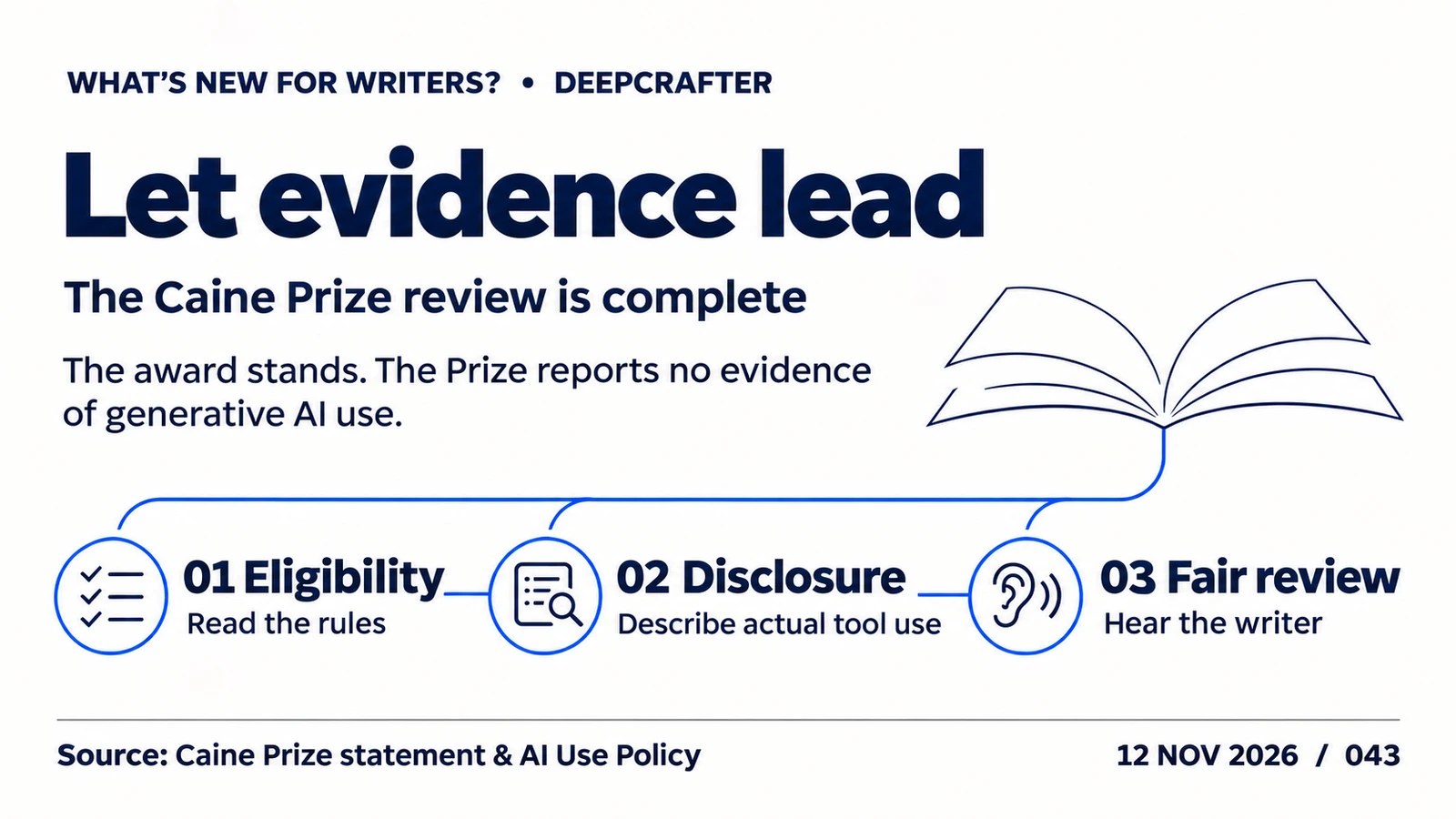
On November 11, 2026, the Caine Prize for African Writing announced that its review of The Blue Fighter, by Simbarashe Steyn Kundizeza, had concluded. The board said it found no evidence that the story had been produced using generative AI. Kundizeza remains the 2026 winner, and the board considers the matter closed.
The announcement also points forward. Alongside its conclusion, the Prize set out declarations and review arrangements for the next submission cycle. For writers and editors, the useful lesson is a practical one: eligibility, disclosure and fair review work best when they are explained together.
What changed on November 11
The review opened on October 11 following an allegation in The Atlantic. According to the Prize's statement, it interviewed the writer, the judging panel and the story's original publisher, The Shallow Tales Review. An independent digital-forensics investigator examined draft metadata. The author and publisher supplied records of the story's development.
Those details matter because they describe an inquiry into a process, not simply a reaction to a passage that sounded unfamiliar. The finding is the Prize's institutional conclusion; the underlying private files have not been independently examined by DeepCrafter. It should be reported accurately without turning it into a verdict on every authorship dispute.
It also updates the public record. An account that stops at “under investigation” is no longer a complete account of this case. Updating a conclusion when new evidence arrives is part of taking the original question seriously.
Literary judgment remains separate. Readers may admire or dislike the story's language, structure or emotional effect. Neither response, by itself, establishes how the story was produced. Equally, the board's decision does not require readers to agree about its literary merit.
Three questions that belong together
The Prize's published AI Use Policy makes three distinct questions easier to ask. The policy records acceptance and effect from November 1, 2026, and applies to submissions from November 23, 2026. November 11 is the date of the public review announcement, not the date the policy was adopted.
1. Eligibility: what may enter?
The submission rules require the writer's own thinking, creativity, voice and judgment. AI-generated content is ineligible even when later edited, rewritten or incorporated into a larger work.
At the same time, the policy distinguishes assistive uses. Accessibility, transcription, spelling, grammar and formatting tools may be used when they do not generate the story or replace the writer's creative contribution. The boundary concerns what a tool does in the work, not merely whether its interface carries an AI label.
These are the Caine Prize's rules. A writer should check the current terms of their actual destination rather than assume that one institution's permissions travel to another. The policy's workplace permissions should not be mistaken for permission to generate a competition entry.
2. Disclosure: what should be explained?
The policy requires material AI use to be disclosed at submission by the publisher, agent or writer. The November 11 statement also announces AI declarations for publisher-submitted stories and shortlisted writers, and guidance for judges for the next cycle.
For a writer, useful disclosure is specific. “I used AI” does not tell an editor whether a tool transcribed an interview, flagged a spelling error or generated dialogue. Those activities make different contributions and may be treated differently by a venue.
Describe the task, the output and what entered the work. Then compare that description with the destination's actual policy. A disclosure does not make otherwise ineligible content eligible; it makes the relevant process easier to understand.
3. Fair review: how should a concern be heard?
The policy treats detection tools as preliminary indicators rather than conclusive evidence. It requires permission from the writer and publisher before running work through such tools.
Its review sequence includes recording the concern, inviting an explanation and supporting information, consulting appropriate stakeholders, using human judgment and communicating the outcome. A writer disputing a decision may request board review through the contact given in the policy.
The constructive idea here is not that every concern must be dismissed. It is that a concern begins a process rather than finishing one. People need to know what is being asked and what information could meaningfully answer it.
Keep a useful record, not a surveillance diary
Our editorial suggestion is to preserve a small amount of process information that already helps your writing. This is not a new requirement announced by the Prize, nor a guarantee of eligibility or a particular review outcome.
Keep a few meaningful draft milestones: an early scene, a structural revision and the submitted version. Add short notes when a major choice changes. Save relevant source references and editorial correspondence. If you use tools, note what they actually contributed.
A compact record might use four headings:
| Item | What to record |
|---|---|
| Draft milestone | Date, version and the main change |
| Creative decision | What you chose and why |
| Source or tool | Material consulted, task performed and output used |
| Destination check | Current policy, required disclosure and date checked |
Consider an original fictional example. A writer changes a train-station scene from a reunion to a missed encounter. A short note—“The missed train lets the daughter act on her own decision”—preserves the logic of the revision. It is useful when the next chapter no longer fits. A corresponding draft helps explain how the scene developed.
If a transcription tool converted a permitted interview recording into notes, record that task precisely. If generated dialogue entered the manuscript, record that honestly too and check eligibility before submitting. The distinction is not cosmetic: this Prize's policy treats generated story content differently from qualifying assistance.
Keep unpublished drafts and personal information private. A sensible record does not require uploading your manuscript to a detector or making every writing session public. Share relevant information through an appropriate process when it is actually needed.
For editors: ask a question someone can answer
An inquiry is more productive when its terms are concrete. Identify the applicable rule, describe the concern and invite relevant information about the work's development. Avoid substituting a stylistic impression or a numerical score for an explanation.
A useful conversation can ask: Which tasks involved a tool? What output entered the submitted text? Which creative choices did the writer make? What drafts or editorial exchanges already exist? Ask proportionately and handle material confidentially; do not demand an exhaustive history simply because keeping one is technically possible.
These are our suggested communication habits, not a claim that the Prize used a particular interview script. Their aim is to make an editor's question answerable and a writer's explanation intelligible.
A clearer place to begin
The Caine Prize's announcement closes one review and makes a future process more explicit. That is a useful development for people who want both strong creative standards and fair treatment.
Writers can take a modest step today: read the rules of the place they hope to submit, describe their actual working methods and retain a few useful traces of revision. Editors can make their boundaries clear before a dispute arises. Readers can distinguish a criticism of the prose from a claim about its origin.
The point is not to replace trust with paperwork. It is to give trust something precise to work with.
Sources and scope
- Caine Prize: review conclusion and next-cycle arrangements, November 11, 2026, noon London. Primary source for the finding, review description, continued award and announced declarations.
- Africa'95 / Caine Prize AI Use Policy, four pages, accepted November 1, 2026. Primary source for eligibility, assistive uses, material-use disclosure, detection permissions and review procedure.
Event and report date: November 11, 2026. Prepared November 12. We verified the public statement and policy, not the private forensic materials. The record template, fictional example and editorial suggestions above are DeepCrafter contributions, not experimental results or official requirements.
More insights on AI creative writing: https://deepcrafter.ai/insights