Help the Right Reader Find Your Book
New metadata research offers a timely prompt to review a book’s identity, description and discovery signals—with a practical audit for writers and publishers.
Help the Right Reader Find Your Book
A novel has more than one beginning. There is the first sentence, where the story opens. There is also the description, search result or catalogue entry through which a reader decides to enter it.
New reporting on NielsenIQ BookData’s metadata research makes that second beginning worth revisiting. The Bookseller covered the research on November 5, 2026; Publishing Perspectives followed on November 6. The public Bookseller introduction attributes to NielsenIQ the view that richer metadata supports discovery and sales. That is the news signal behind this article—not a claim that a stronger description guarantees a bestseller.
For authors and small publishing teams, the constructive question is straightforward: does the information surrounding your book help the right person recognize it?
What the news changes—and what it does not
Metadata is the structured information attached to a book: its identity, contributors, edition, format, subject and descriptive material. Some elements help a supply chain distinguish one product from another. Others help a reader understand what kind of experience is being offered.
Those functions belong together. A beautiful description attached to the wrong edition is not useful. An immaculate product record with vague copy can still leave a potential reader unsure whether the story is for them.
The full 2026 NielsenIQ report is available through a request form; we have not reviewed it in full. We therefore do not reproduce headline sales multipliers or infer a causal effect from the trade coverage. The exact release date is not established here: the report was already being covered on November 5, not newly launched on November 6.
The practical framework below is DeepCrafter editorial analysis, not a procedure attributed to NielsenIQ. Its value is a clearer and more accurate reader invitation, whether or not it changes sales.
Three layers of a useful reader invitation
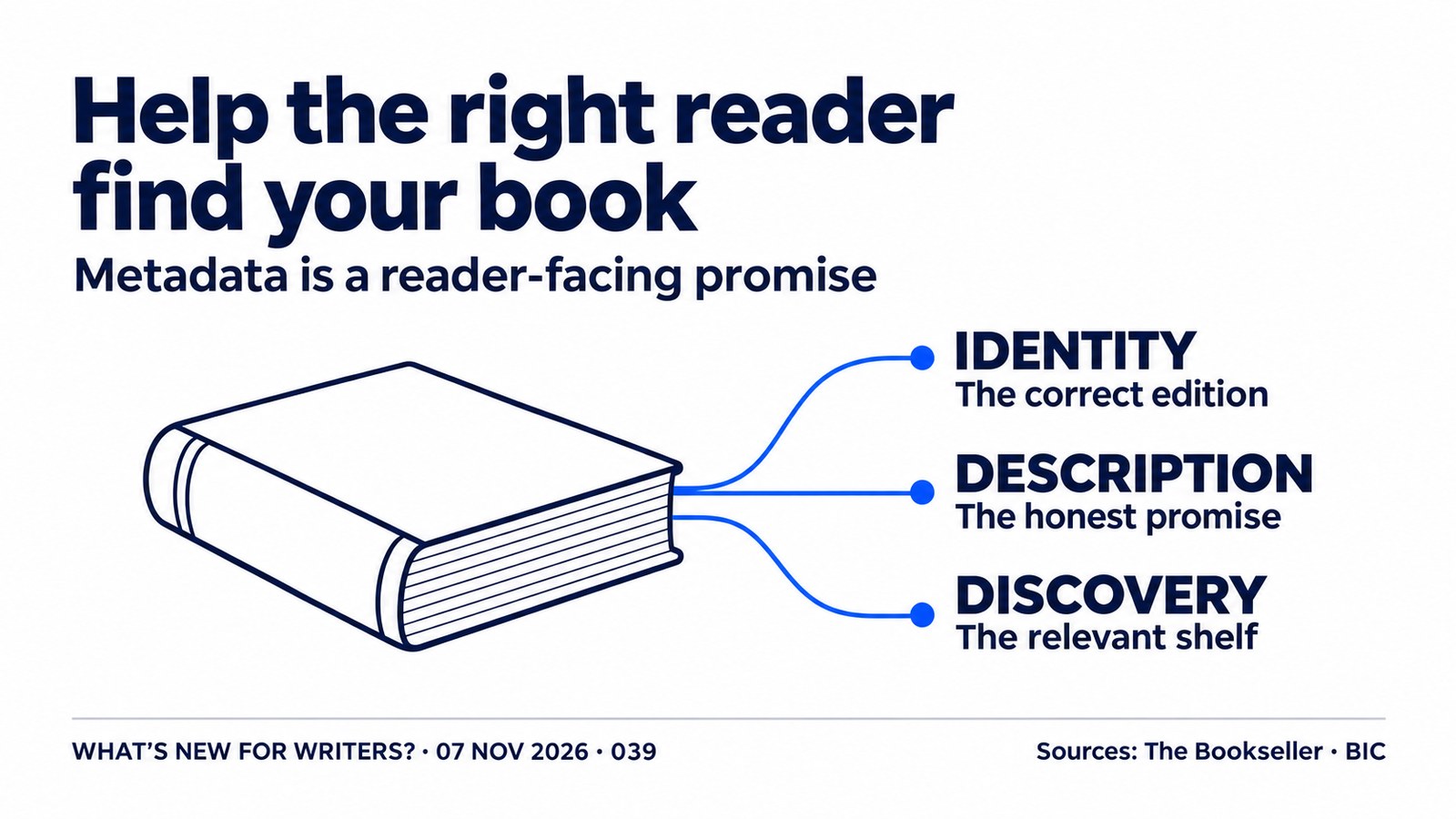
1. Identity: is this the correct book?
Start with facts that should not be creative: title, contributor names, format, edition, language, publication information and identifiers where applicable. Check translator credits as carefully as author credits. A paperback and an audiobook may share a story while requiring different product information.
This is not glamorous work, but it protects reader trust. Someone buying a translation, a particular edition or a specific format should be able to identify it without guessing.
For a traditionally published author, the action may be to send a concise correction request to the publisher. For an independent author, it may be to review the distributor record and then inspect the actual retailer display. Different people control different parts of the chain; begin with the records you can influence.
2. Description: what experience are you promising?
A book description is not a plot inventory. It gives a potential reader enough orientation to decide whether to continue: a person, a situation, a pressure and a distinctive texture.
Consider this invented description:
A moving, unforgettable novel about secrets, family and the power of hope.
It conveys enthusiasm but little that distinguishes this book from thousands of others. Now consider a second original version:
When a night-shift archivist discovers that her mother’s letters have been filed under another woman’s name, she has one week before the city archive closes to learn which history her family chose to keep.
The second version offers a role, an anomaly, a deadline and an emotional question. It does not need to reveal the ending or claim universal importance. If the novel is quiet and reflective rather than a thriller, the surrounding copy should make that tone clear too. A deadline alone should not misrepresent the reading experience.
Write two sentences answering: who is this about, what unsettles their life, and what makes this telling particular? Then compare them with the manuscript. Delete any promise the actual book does not keep.
3. Discovery: where does it genuinely belong?
Subject classifications and search language help describe a book’s place among other books. Choose the relevant shelf, not every shelf with traffic. A story containing a romantic relationship is not automatically a genre romance; a future setting alone does not tell readers whether to expect hard science, satire or a family drama.
Book Industry Communication’s August 2024 Metadata Excellence Award checklist provides useful background. For applicants to that UK-focused scheme, it requires Thema subject classification and emphasizes regular checks for inaccurate or contradictory information. These are requirements within a particular accreditation scheme, not a claim that every author worldwide must use the same process.
The broader editorial lesson is portable: use the vocabulary appropriate to your publishing channel, and make sure your classifications agree with the description and the book itself.
A compact audit you can finish today
Choose one published or forthcoming title and make a three-column working sheet: field, current display, action.
- Identity pass: compare title, names, credits, edition and format against the approved publication record. Log discrepancies rather than silently inventing missing details.
- Promise pass: ask an unfamiliar reader what genre, tone and central situation they infer from the description. Compare that response with your intention.
- Discovery pass: check whether subjects and keywords describe the actual story. Remove irrelevant bait; ask the publisher or distributor about any classification you cannot interpret.
- Display pass: open the live listing. Check truncation, missing credits and mismatched covers. A correct source record does not by itself prove every downstream display is correct.
Give each action an owner and a place to verify the correction. The deliverable is not a long list of aspirational improvements. It is one accurate publication record and one reader-facing description whose promises you can defend.
Where an AI assistant can help
An assistant can draft alternative descriptions from a fact sheet, flag inconsistent names or ask what a reader might infer from a proposed blurb. Treat those outputs as candidates for editorial review, not verified publication data.
A useful prompt is: “Using only the supplied facts, write two descriptions with different emphasis. List every factual statement separately. Mark anything the source material does not establish.” Then check the statements yourself and read the candidates against the actual story.
Do not ask a model to invent awards, reviews, comparisons or contributor credentials to make the package persuasive. Specificity is strongest when it comes from the work, not from decoration.
Another form of care for the story
Discovery is not a substitute for writing well. It is part of giving the finished work a fair introduction. The task is not to make every reader click. It is to make the right reader understand what is waiting behind the first page.
Sources and scope
- The Bookseller, November 5, 2026: coverage of NielsenIQ BookData’s metadata research. Public introduction checked; subscriber-only detail is not treated as read.
- Publishing Perspectives, November 6, 2026: report coverage. Title and date independently confirmed through its public index; full article access was blocked during this check.
- NielsenIQ BookData report request form. Full report not reviewed.
- BIC Metadata Excellence Award Publisher Check List, August 2024, version 1.2. Primary background document, not new November 2026 guidance.
The examples, audit and AI prompt are original editorial suggestions. No sales uplift, platform ranking outcome or product test is claimed.