Keep the Authorial Decisions
The Mark Twain House AI-writing symposium agenda prompts a practical question: how can assistance strengthen, rather than replace, a writer’s judgment?
Keep the Authorial Decisions
An AI-assisted draft can become fluent before a writer has decided what it means. The useful response is not to abandon assistance, or to accept every smooth sentence. It is to make the important decisions visible.
A timely prompt comes from the Mark Twain House & Museum in Hartford, Connecticut. Its official program scheduled Creative Writing in the Age of AI for November 7, 2026, from 9:30 a.m. to 3 p.m. The announced conversations connect questions about creative work with editing, teaching and reading. That combination matters: writing is not only the production of text, but also the development of judgment.
This article uses the published advance program, not verified proceedings. We have not established what participants actually said or whether every session took place as scheduled. The practice below is our editorial response to the agenda, not a recommendation attributed to its speakers.
The useful shift: from output to decisions
The museum's program places legal and ethical frameworks alongside the working lives of authors and editors, then turns to teaching and reading. These are related but different questions. A tool's ability to produce a paragraph does not tell a writer whether that paragraph serves a particular story. Nor does a polished result reveal whether the writer learned anything from making it.
For a working novelist, this suggests a manageable question: Which decisions do I want to make myself, and how will I know I made them?
That question is useful whether you ask a model for alternatives, use an editor's suggestions, or revise entirely on your own. The goal is not to prove purity. It is to give your work a direction you can recognize and explain.
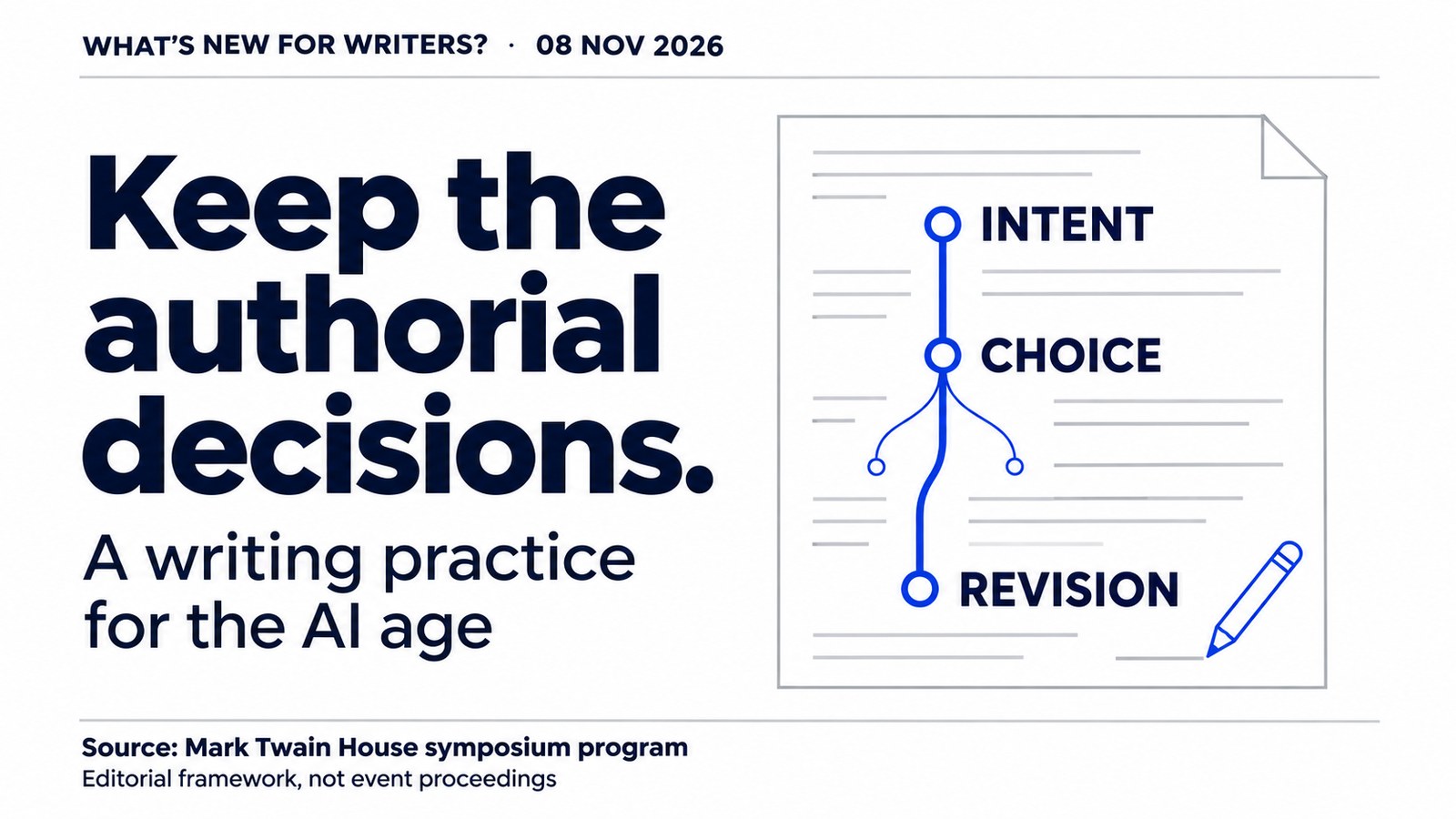
1. Intent: decide what must remain true
Before asking for a revision, write a short scene brief. Name the viewpoint, the character's immediate desire, the pressure that obstructs it, and the change the scene should produce. Add one thing the prose must not explain too early.
Consider an original fictional example: a daughter returns a borrowed key to her estranged father. She wants him to ask her to stay. He thinks she wants permission to leave. The scene should end with a small act of care, not a reconciliation speech.
A brief like that makes revision more precise. “Make this more emotional” invites any recognizable sign of emotion. “Keep both characters from naming what they want; let the returned key carry the tension” defines a narrative choice.
If you use an assistant, supply only material you are entitled to share and respect any publisher, client or institution's applicable rules. The craft exercise is not a substitute for checking those requirements.
2. Choice: ask for contrast, then choose for a reason
Alternatives are most useful when they differ in a meaningful way. Instead of requesting a better version, ask for two approaches to the same problem: one that makes the father's hesitation visible through action, and one that lets the daughter misread his silence. Keep the scene facts fixed.
Then compare the consequences. Which version keeps the daughter at the center of perception? Which makes the ending feel earned? Which adds a fact you did not intend? You may choose neither and write a third version yourself.
A possible prompt is:
Using only my scene brief and excerpt, propose two revision approaches, not a full rewrite. Explain how each changes viewpoint, tension and what the reader knows. Flag any assumption the excerpt does not support.
This is a suggested workflow, not a claim about a particular model's tested performance. Evaluate any response against your own text.
The important artifact is a sentence of reasoning: “I kept the father's movement toward the kettle because it offers care without resolving the estrangement.” That sentence tells you more about authorship than the number of suggestions you accepted.
3. Revision: keep a small decision record
A decision record need not become administrative work. For one scene, keep three short notes:
- Kept: a detail that does necessary work.
- Rejected: an attractive change that damages the intention.
- Rewrote: a passage you changed after understanding the problem more clearly.
For the key scene, you might reject an eloquent apology because it answers the question too soon. You might keep an awkward pause because the characters cannot yet speak directly. You might rewrite a generic gesture into an action particular to this father.
These notes are working memory, not a certificate of originality or a legal determination. Their practical value is that you can return tomorrow and recover the logic of the scene instead of starting from whichever version sounds most polished.
A twenty-minute practice
Choose a short scene you can comfortably reread in a few minutes. Spend four minutes writing the intent brief. Spend five identifying two genuinely different revision possibilities, with or without assistance. Spend eight revising the passage yourself. Use the final three to read it aloud and write the three decision notes.
At the end, ask a reader-facing question: what can someone now infer that the old version merely announced? If the answer is unclear, you have a useful next task. You do not need another thousand words of output.
The announced symposium also includes teaching, learning and reading. Our editorial takeaway is that a writing practice should leave the writer better able to notice, compare and decide. A tool can contribute to that process when its suggestions become material for thought, rather than the end of thought.
Keep the assistance where it helps. Keep the decisions where you can see them.
Sources and scope
- Mark Twain House & Museum: official symposium program. Announced date, time, location, participants and session descriptions independently read. This is an advance agenda, not a transcript.
- Museum announcement, October 5, 2026. Original announcement; direct access was blocked during this check.
- Connecticut Office of Tourism event listing. Independently corroborates the November 7 date, Hartford location and scheduled hours. Registration details differ from the official program, so no price claim is made here.
The fresh event hook is the scheduled November 7 gathering, not a new November announcement. The scene, prompt, decision record and timed practice are original editorial suggestions; no speaker endorsement, consensus or measured benefit is claimed.