What’s New for Writers? October 25, 2026
Five verified developments across world literature, publishing and AI-assisted writing—from the Tom Wolfe Prizes to productive friction.
What’s New for Writers? October 25, 2026
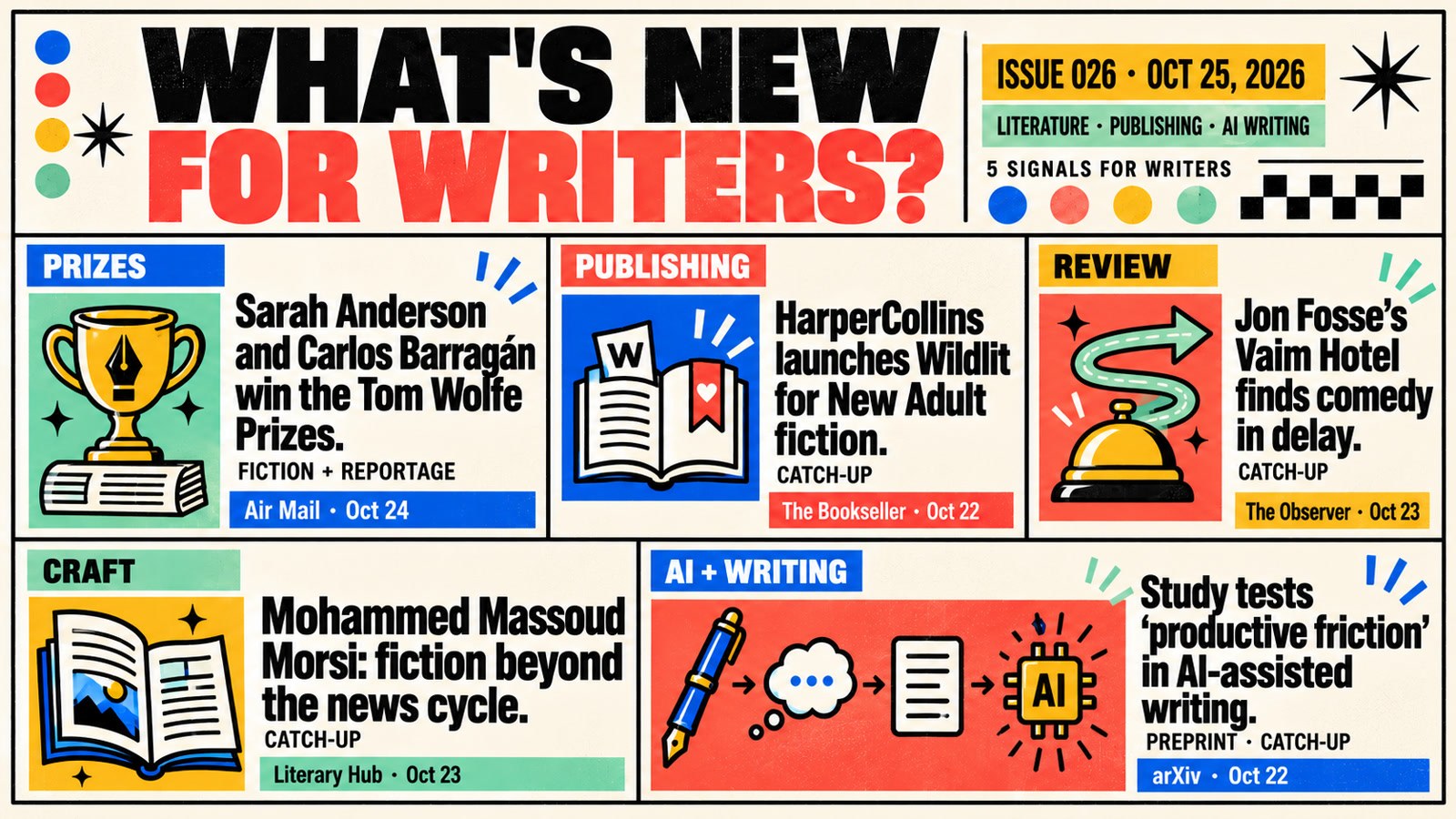
A young prize puts fiction beside reportage. A major publisher builds a home for New Adult fiction. A review finds comedy inside Jon Fosse’s delays. A novelist asks what fiction can preserve after the news cycle moves on. And a new preprint tests whether making AI writing assistance slightly harder can make the work better.
This edition covers developments verified by 09:00 Beijing time on October 25, 2026. Where the 24-hour window produced too few meaningful additions, clearly marked items extend to 72 hours.
1. The Tom Wolfe Prizes pair fiction with reportage
Air Mail’s October 24 issue announced the winners of the second Tom Wolfe Prizes. Sarah Anderson received the fiction prize for Fallow, while Carlos Barragán received the reportage prize for The Yahoo Boys.
The pairing is the interesting part for writers: two forms with different truth contracts are being placed in conversation around style and contemporary life. Fiction can invent in order to reach experience; reportage must remain accountable to documented reality. Reading the winners side by side offers a useful question: what can each form notice that the other cannot?
The prize is still young, so this announcement should not be treated as evidence of broad industry influence. It is better read as a fresh editorial signal—and as two works newly worth investigating.
2. HarperCollins launches Wildlit for New Adult readers
72-hour catch-up. The Bookseller reported on October 22 that HarperCollins is launching Wildlit, an imprint focused on commercial, cross-genre fiction for New Adult readers, with romance running across the list.
One of its first announced titles is The Emberquell Academy, a work that moved from self-publishing toward traditional publication. Its planned release is June 2027, not this week. That distinction matters: the current news is the imprint strategy and acquisition pipeline, not a new book arriving in stores.
For writers, Wildlit is another sign that large publishers are giving the New Adult audience a more explicit editorial identity. The practical signals to watch are how self-published traction is evaluated, which series rights are acquired, and how broadly “New Adult” stretches across fantasy, romance and other commercial genres. Claims that the market is “fast-growing” remain the publisher’s assessment rather than an independently verified conclusion here.
3. Jon Fosse’s Vaim Hotel finds comedy in delay
72-hour catch-up. In an October 23 review for The Observer, Chris Power considers Vaim Hotel, the second book in Jon Fosse’s Vaim trilogy, translated into English by Damion Searls. Power connects the hotel’s repeatedly frustrated and confused guest with Kafkaesque farce.
That offers writers a productive way into Fosse beyond solemnity. Repetition, interruption and syntactic continuation do not only create meditation or unease; they can also create comic timing. A character who cannot complete a simple action because the world keeps slightly obstructing him can be both existentially stranded and funny.
October 23 is the date of the review, not a verified publication date for the book. The item is included for the critical angle, not as a release announcement.
4. Mohammed Massoud Morsi on writing lives beyond headlines
72-hour catch-up. Literary Hub published a first-person essay by Mohammed Massoud Morsi on October 23 about his movement from journalism toward fiction after reporting in Gaza. His central concern is what immediate coverage compresses: ordinary routines, private desires, relationships and the continuities of a life that outlast a news cycle.
The essay raises an ethical craft question. When violence dominates the frame, how can a writer avoid reducing people to casualties, testimony or political symbols? Fiction cannot replace reporting, but it can create temporal and emotional room for a person to want, remember, contradict themselves and continue living beyond the thematic function assigned to them.
This is the author’s reflection on his practice. Events he recalls are not presented here as developments from this week.
5. Can “productive friction” improve AI-assisted writing?
Preprint · 72-hour catch-up. Submitted on October 22, Metacognitive Scaffolds Create Productive Friction for AI-Assisted Knowledge Work reports a randomized experiment involving 297 workers and 594 articles.
Instead of making generation maximally effortless, the tested system used dynamic prompts that asked writers to clarify goals, break work into parts and engage more deliberately with the task. The researchers report improvements in writing quality and in recall of the article topic three days later. Participants, however, experienced the AI as more mentally demanding and less helpful.
That tension is the useful finding for writing tools: the interface people enjoy most in the moment may not be the one that best supports attention, ownership or learning. A practical workflow worth testing is to define the writing goal, task structure and evaluation criteria before generating prose.
The evidence boundary matters. This is a preprint experiment on article writing. It does not establish the same effect for long-form fiction, nor does it validate any particular commercial product.
What to read first
Start with Mohammed Massoud Morsi’s essay. It turns a large argument about literature and witness into a precise craft test: after the headline has passed, does your character still possess a life larger than the subject you need them to represent?
Sources
- Air Mail: Announcing the Winners of the 2026 Tom Wolfe Prizes
- The Bookseller: HarperCollins launches New Adult imprint Wildlit
- The Observer: Jon Fosse welcomes you to the Vaim Hotel
- Literary Hub: Mohammed Massoud Morsi on writing Palestinian lives beyond the headlines
- arXiv: Metacognitive Scaffolds Create Productive Friction for AI-Assisted Knowledge Work
Source status checked October 25, 2026. Catch-up and preprint labels are preserved so review dates, release dates and research status are not conflated.
Sources
- Air Mail: Announcing the Winners of the 2026 Tom Wolfe Prizes
- The Bookseller: HarperCollins launches New Adult imprint Wildlit
- The Observer: Jon Fosse welcomes you to the Vaim Hotel
- Literary Hub: Mohammed Massoud Morsi on writing Palestinian lives beyond the headlines
- arXiv: Metacognitive Scaffolds Create Productive Friction for AI-Assisted Knowledge Work