What Counts as Evidence for an AI Writing Coach?
A five-part test for judging whether an AI writing coach improves learning—not only the assisted draft.
What Counts as Evidence for an AI Writing Coach?
A five-part test for separating a promising design from a proven learning tool.
On October 26, the University of Pittsburgh’s School of Computing and Information described a planned AI writing coach, tentatively named InspireWrite. Its proposed behavior is deliberately different from a general-purpose chatbot: instead of returning a polished essay, it would ask questions that help students develop an interesting sentence, word choice or idea.
That is a promising design hypothesis. It is not yet evidence that the tool improves writing.
The distinction matters because an AI system can make a draft look better while leaving the writer no better able to write. It can feel supportive while narrowing voice. It can keep data on a university server while still leaving unanswered questions about access, retention and future use. If we want to know whether an AI writing coach is genuinely effective, we need evidence about learning, not merely evidence that the interface works.
What Pitt has announced — and what it has not
The university’s announcement describes a project in development, not a finished product or completed efficacy study.
What is known
- The planned tool is intended for short personal essays common in composition courses.
- Its proposed intervention is question-led feedback rather than a submission-ready rewrite.
- The research team includes expertise in natural language processing, educational technology, learning science and English composition.
- The team is assembling a multimodal dataset from Pitt classrooms: student drafts, instructor comments and audio from one-to-one paper conferences.
- Pitt reports participation from roughly 20 course sections, 12 to 13 instructors and about 100 students. Participation is described as individually consented and compensated.
- The planned system would use a smaller language model hosted locally at Pitt.
- The project has received several awards, including $100,000 from the Tools Competition 2026 and $250,000 from Digital Promise’s K–12 AI Infrastructure Program.
What is not yet established
The announcement does not report a completed trial, learning gains, comparison groups, effect sizes, independent replication or evidence that gains persist when the tool is removed. It also does not provide enough detail to evaluate dataset representativeness, data-retention rules or subgroup outcomes.
That is not a criticism of an early-stage project. It is simply the correct evidence label: funded and under development.
First decide what “effective” means
An AI writing coach can succeed at several different things:
- making the current draft stronger;
- helping the writer make better revision decisions;
- improving the writer’s underlying skill;
- preserving ownership, voice and willingness to write;
- delivering that help safely and fairly.
These outcomes overlap, but they are not interchangeable. A cleaner final paragraph may show that the system can edit. It does not show that the student learned to diagnose or revise the next paragraph independently.
A 2025 randomized study of 90 undergraduates is useful here. It compared a chat-based model, an integrated writing-support tool and a standard writing interface. Among the two AI-supported conditions, the purpose-built tool was associated with greater writer agency and deeper knowledge transformation. The study does not prove that every integrated coach works; it shows why the form of assistance and the learning process deserve measurement alongside the final text.
The right evaluation therefore begins with a theory of change: What action should the coach prompt, what mental work should the writer perform, and what later ability should improve?
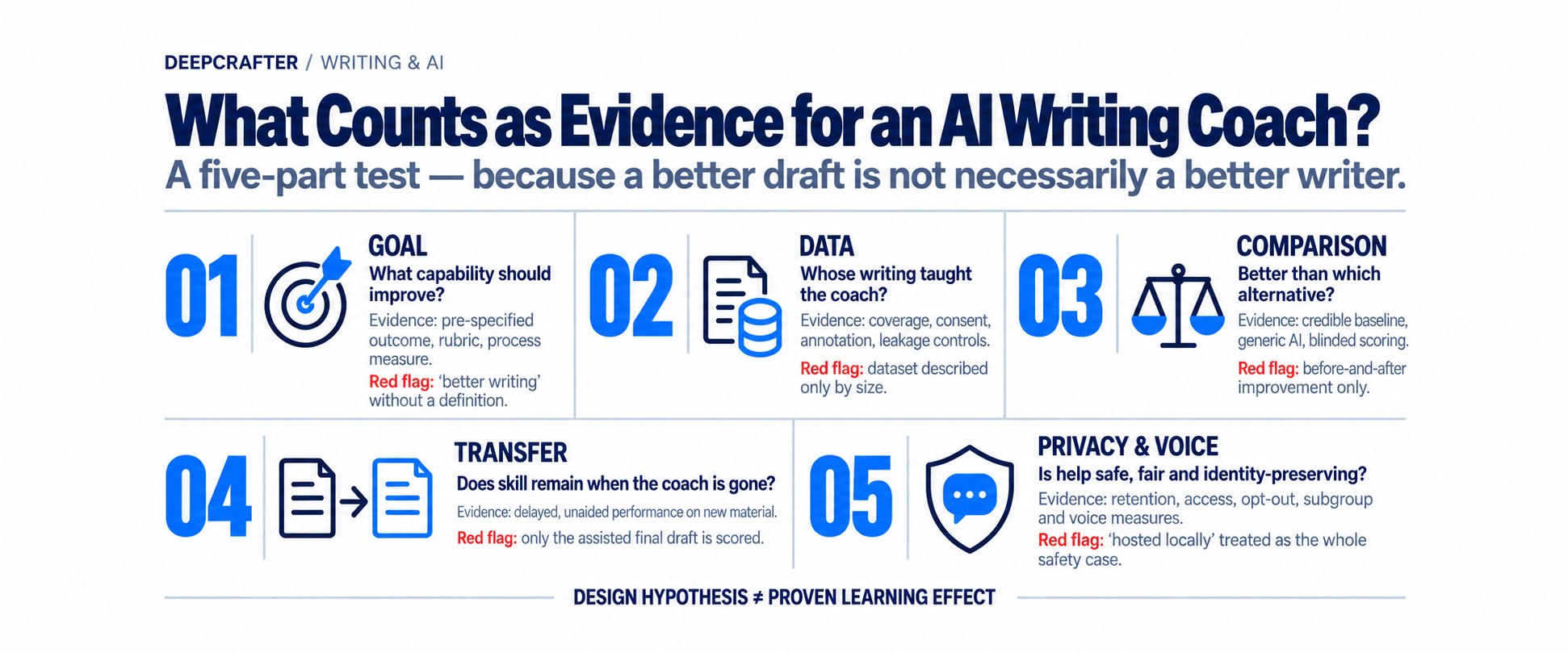
The five-part evidence test
1. Goal: name the capability, not the aspiration
“Supports creativity” is too vague to test. A credible study should identify a specific target such as generating more distinct ideas, explaining revision choices, developing evidence, preserving a chosen voice or transferring a revision strategy to a new essay.
Before seeing results, researchers should specify:
- the primary outcome;
- how it will be measured;
- who will rate it;
- when it will be measured;
- what would count as a meaningful improvement.
The strongest outcomes combine product and process. Evaluate the draft, but also examine revision logs, student explanations, help-seeking behavior and the degree to which the writer accepts, rejects or transforms suggestions.
Evidence to ask for: a pre-specified learning claim, a scoring rubric, process measures and a threshold for practical—not merely statistical—importance.
2. Data: show whose writing taught the coach
A coach trained on paper conferences may capture something valuable that generic web text misses: how instructors notice a promising phrase, ask for elaboration and return agency to the writer. But a dataset is not automatically representative or ethically reusable because it was collected in a classroom.
Evaluation should disclose:
- which courses, genres, proficiency levels and language backgrounds are represented;
- how instructor feedback was selected, transcribed and labeled;
- whether train, validation and test sets prevent the same student or assignment from leaking across splits;
- how disagreement between instructors is handled;
- what students consented to, including any public release or future model training;
- whether participants can withdraw their data later.
Small or local datasets can still be useful. The problem is not locality; it is pretending that one context represents every writer.
Evidence to ask for: a dataset card, consent and withdrawal procedures, demographic and course coverage, annotation guidance, leakage controls and known gaps.
3. Comparison: test the coach against real alternatives
A before-and-after improvement is weak evidence by itself. Students often improve after spending more time on a draft, receiving any feedback or simply writing a second version.
A useful comparison should separate at least four possibilities:
- writing without automated feedback;
- receiving feedback from a general-purpose chatbot;
- using the purpose-built coach;
- receiving human instructor or peer feedback where feasible.
Assignment, time, instructions and access to other help should be held as constant as possible. Random assignment strengthens causal claims. Blinded raters should score de-identified texts, and the analysis should report uncertainty and effect sizes rather than only whether a result crossed a significance threshold.
Researchers should also track costs: time spent, instructor workload, model expense, dropout and how often students ignore or misunderstand feedback. A system that produces a small gain at a large burden may not be the best intervention.
Evidence to ask for: a credible baseline, a generic-AI comparison, blinded assessment, comparable task conditions, effect sizes and a record of cost and attrition.
4. Transfer: remove the coach and test again
This is the decisive test of learning.
If students write better only while the tool is present, the system may be useful assistance—but it has not yet demonstrated instruction. To claim that a coach builds skill, researchers should test students later, without the tool, on a new prompt and ideally in a different but related genre.
A strong evaluation could include:
- an immediate unaided task;
- a delayed task several weeks later;
- a new topic that prevents memorized reuse;
- a genre shift that tests whether the strategy generalizes;
- an explanation task in which students diagnose a passage and justify a revision.
Transfer can also fail in subtler ways. Students may learn to wait for a question rather than generate one themselves, or imitate the coach’s preferred structure. Those outcomes would be hidden if researchers scored only the assisted final essay.
Evidence to ask for: delayed, unaided writing on unfamiliar material plus a measure of whether students can explain and reuse the underlying strategy.
5. Privacy and voice: measure the conditions of help
Local hosting can reduce exposure to outside providers, but location alone is not a privacy policy. Student drafts and recorded conferences may contain personal disclosures, grades, disabilities, family history or unpublished creative work.
An evaluation should document:
- what is collected and why;
- who can access raw drafts, audio and derived data;
- encryption, retention and deletion rules;
- whether inputs or feedback are used for later training;
- how consent works when participation is connected to a course;
- how students can opt out without academic disadvantage;
- what happens after a security or model failure.
NIST’s AI Risk Management Framework treats validity, privacy, fairness, transparency and accountability as connected properties across an AI system’s lifecycle. For a writing coach, that means privacy and voice are not compliance footnotes. They are part of effectiveness.
Voice also needs direct measurement. Researchers can compare lexical and syntactic diversity before and after assistance, look for convergence across students, and ask writers whether suggestions preserved the meaning and identity they intended. Subgroup analysis matters: a coach that works well on average may still misread dialect, multilingual expression or culturally specific language.
Evidence to ask for: data-governance documentation, opt-out and deletion mechanisms, subgroup results, voice-preservation measures and post-deployment incident monitoring.
A practical evidence ladder
The word “effective” should be earned in stages.
Stage 1 — Feasibility
Can the system produce relevant, safe questions? Do instructors recognize the feedback strategy? Can students understand what to do next?
Stage 2 — Controlled efficacy
Under defined conditions, does the purpose-built coach outperform a credible baseline on pre-specified outcomes?
Stage 3 — Learning transfer
Do writers perform better later, without the tool, on new material?
Stage 4 — Field effectiveness
Does the benefit survive across instructors, courses, student groups and a full term of real use? What are the workload and failure rates?
Stage 5 — Responsible durability
Are gains maintained over time? Are privacy, equity and voice outcomes monitored after deployment? Can the institution detect drift, appeal harmful feedback and retire the system safely?
Funding, a compelling demo and positive user comments belong near the beginning of this ladder. They are reasons to keep testing, not substitutes for the later steps.
The shortest useful scorecard
Before accepting a claim about an AI writing coach, ask five questions:
| Test | Minimum credible evidence | Warning sign |
|---|---|---|
| Goal | A specific learning outcome and pre-specified rubric | “Better writing” with no operational definition |
| Data | Documented coverage, consent, annotation and leakage controls | A dataset described only by its size |
| Comparison | A credible baseline, comparable conditions and blinded scoring | Before-and-after improvement only |
| Transfer | Delayed, unaided performance on new material | Only the assisted final draft is scored |
| Privacy & voice | Retention, access, opt-out, subgroup and voice measures | “Hosted locally” treated as the whole safety case |
A promising direction, with the evidence still ahead
InspireWrite’s proposed refusal to hand back a polished essay is a meaningful design choice. So is the effort to learn from real instructor conferences rather than treating generic model output as pedagogy. Those choices make the project worth watching.
But good intentions, thoughtful design and funding are inputs. Evidence arrives only when the project defines its claims, tests them against alternatives, measures independent transfer and documents whose data and voice are protected.
The most important question is not whether an AI can improve this page. It is whether the writer can approach the next page with more judgment, range and confidence after the AI is gone.
Sources
- University of Pittsburgh School of Computing and Information: “SCI researchers receive funding to develop AI writing coach tool” (October 26, 2026)
- Siddiqui, Feliciano, Pea & Subramonyam: “AI in the Writing Process: How Purposeful AI Support Fosters Student Writing” (AIED 2025)
- Guo, Wang, Heer & Zhang: “Preserving Writer Values in AI Writing Assistance Tools” (In2Writing 2024)
- NIST: Artificial Intelligence Risk Management Framework
- NIST: Artificial Intelligence Risk Management Framework — Generative AI Profile