Eight Gothic Classics for Halloween Night: A Reading Map of Four Fears
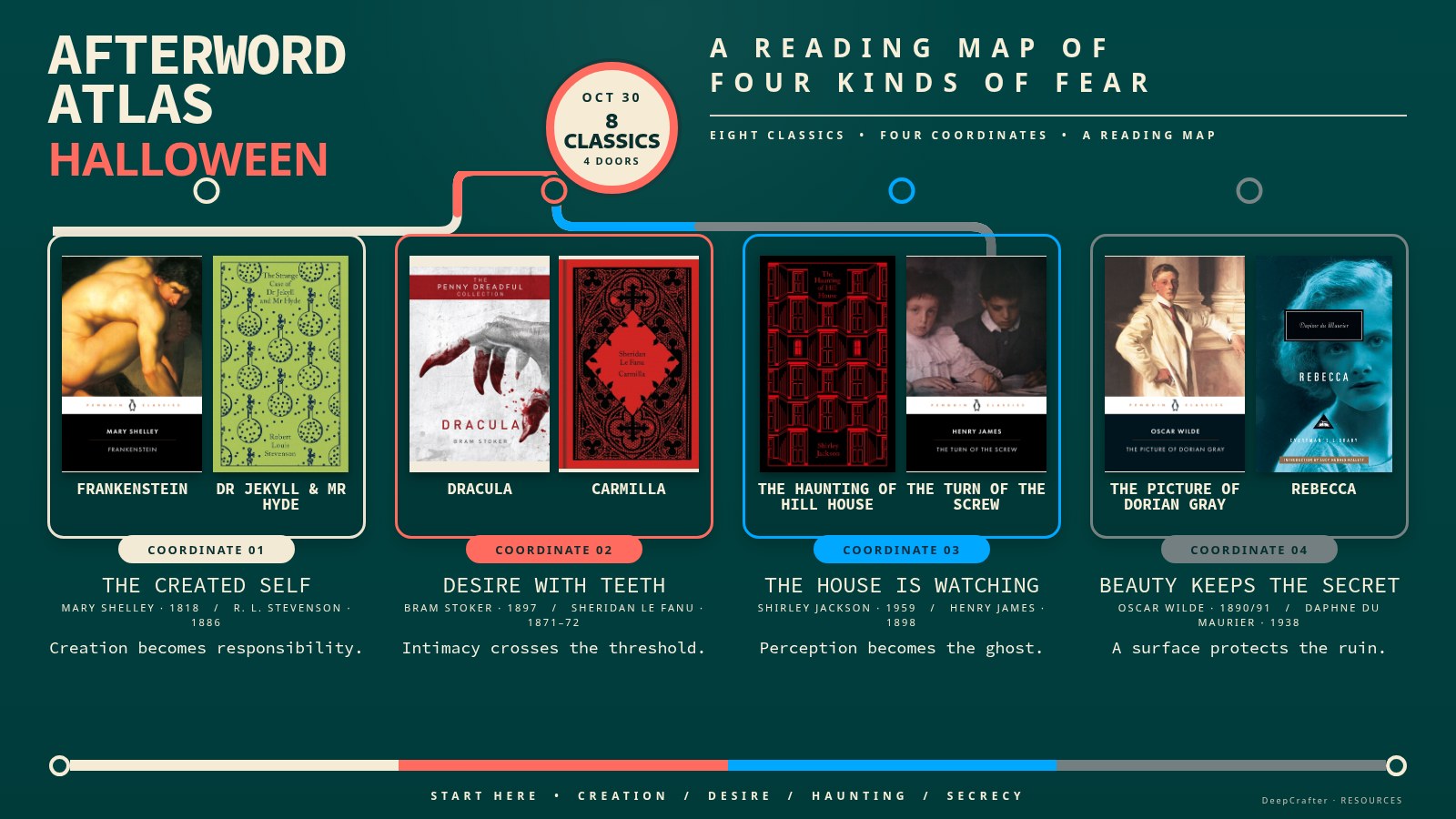
Choose your Halloween reading by the fear you want: created selves, vampires, haunted houses or beautiful secrets—eight classics across four clear routes.
Eight Gothic Classics for Halloween Night: A Reading Map of Four Fears
Halloween reading is often sold as a hunt for the scariest book. The classics offer a better question: what kind of fear do you want to enter?
Some books frighten us with a body made against nature. Some let desire cross the threshold wearing a beautiful face. Some make a house feel conscious. Others need no supernatural creature at all: a portrait, a memory or a divided self can do the haunting.
That is why October 30 is a particularly good day to choose by atmosphere rather than reputation. The eight books below form four routes, with one more accessible entrance and one deeper companion on each path. You do not need to read them in publication order, and this is not a ranking. Pick the fear that already has a key to your imagination.
Four doors. Eight classics. Choose the fear you want to follow.
Route I · The created self
1. Frankenstein — Mary Shelley (1818)
Read for: a monster story in which creation is only the first moral failure.
Victor Frankenstein succeeds at the impossible and then refuses responsibility for the life he has made. The popular image of a mute, lumbering monster can obscure how verbal and self-aware the Creature is in the novel. He reads, reasons, longs for companionship and learns cruelty from rejection.
That makes Frankenstein a strong Halloween starting point for readers who want more than pursuit and shock. Its deepest terror lies in the distance between invention and care: what does a creator owe the being that must live with the consequences?
Notice: the nested narration. Walton hears Victor, Victor recounts the Creature, and each voice tries to control our sympathy.
Edition note: readers choosing between the 1818 and 1831 texts should know that Shelley revised the novel substantially. The MIT Press edition listed below uses the original 1818 text; many current classics editions use the later version.
Content note: death, grief, abandonment and violence.
2. Strange Case of Dr Jekyll and Mr Hyde — Robert Louis Stevenson (1886)
Read for: the short, fogbound classic that turns respectability into suspense.
The cultural shorthand is “good man versus evil alter ego,” but Stevenson's novella is stranger and more exact. Jekyll does not simply discover Hyde; he creates a structure that lets appetite act without consequence. The horror grows from secrecy, reputation and the fantasy that one part of a life can remain sealed away from the rest.
Its compactness makes it ideal for one sitting. Read it after Frankenstein and compare the two experiments: one produces a rejected other, while the second tries to divide the self from its own responsibility.
Notice: how long Stevenson withholds direct access to Jekyll. Lawyers, letters, locked doors and partial testimony make the revelation feel like a legal and social catastrophe, not only a supernatural one.
Content note: violence, substance use and suicide.
Route II · Desire with teeth
3. Dracula — Bram Stoker (1897)
Read for: a large, propulsive archive of fear.
Stoker builds the novel from journals, letters, telegrams, newspaper reports and memoranda. That documentary structure gives a supernatural invasion the texture of modern information gathering: the characters survive by pooling records that no single witness can understand alone.
The novel is more mobile than its castle-bound reputation suggests. It moves from Transylvania to Whitby and London, from private bedrooms to rail timetables, blood transfusions and typewriters. The fear is ancient, but the response is collaborative and technologically current for its moment.
Notice: who gets to record an event, whose account is believed and how Mina turns scattered testimony into a usable map.
Best for: readers who want a long Halloween read with pursuit, atmosphere and a group of characters to follow.
Content note: blood, illness, death, sexual threat and period attitudes toward gender and race.
4. Carmilla — Sheridan Le Fanu (1871–72)
Read for: the intimate vampire story that came before Dracula.
Laura's secluded life changes when the beautiful and mysterious Carmilla becomes a guest in her father's castle. Affection, fascination and danger remain deliberately entangled. The story's power comes from that closeness: the threat is not a distant figure at the window but a companion already inside the household.
Read Carmilla beside Dracula to see two different architectures of vampirism. Stoker expands fear across documents, cities and a coordinated hunt; Le Fanu concentrates it in secrecy, desire and the uncertain language available to Laura.
Notice: the gap between what Laura feels and what the adults around her are willing or able to name.
Best for: a shorter, more sensuous route into Gothic vampirism.
Content note: predation, illness, death and queer desire filtered through nineteenth-century Gothic conventions.
Route III · The house is watching
5. The Haunting of Hill House — Shirley Jackson (1959)
Read for: a haunted-house novel that makes perception itself unstable.
Dr Montague invites a small group to Hill House to investigate its reputation. The story gradually fastens itself to Eleanor Vance, who arrives after years of caring for her mother and with almost no life she can call her own. The house may be supernatural, but its most disturbing power is how precisely it seems to answer her loneliness.
Jackson's prose moves between dry comedy, social discomfort and dread without announcing the transition. Rooms refuse to align; doors swing shut; a message on a wall becomes both evidence and accusation.
Notice: when the narration moves closer to Eleanor's thoughts. The central question is not simply whether Hill House is haunted, but whether the house and Eleanor can still be separated.
Best for: readers who want psychological ambiguity without losing the pleasures of a classic haunted house.
Content note: grief, isolation, psychological distress and death.
6. The Turn of the Screw — Henry James (1898)
Read for: a ghost story that never lets interpretation settle.
A young governess takes charge of two children at an isolated country estate and becomes convinced that malevolent figures are trying to reach them. Every apparent clue intensifies the uncertainty. Are the children endangered, complicit or misunderstood? Is the governess protecting them—or imposing a story they cannot escape?
The novella asks the reader to perform the very act it distrusts: interpretation. Each rereading can shift which gesture looks innocent, which silence looks deliberate and which witness seems reliable.
Notice: the frame narrative. Before the governess speaks, her manuscript is introduced as an object passed between storytellers. The story arrives already shaped by performance and delay.
Best for: readers who enjoy arguing with a book after the last page.
Content note: child endangerment, psychological distress and death.
Route IV · Beauty keeps the secret
7. The Picture of Dorian Gray — Oscar Wilde (1890; revised 1891)
Read for: wit, beauty and corruption stored in a single hidden object.
Dorian remains young while his portrait records the damage of his choices. The premise is supernatural, but the novel's real engine is social: influence becomes an alibi, appearance becomes a shield and aesthetic language can make cruelty sound like philosophy.
Wilde's only novel exists in more than one important form. The 1890 magazine text was revised and expanded for the 1891 book edition. Most current editions use the later version, but readers interested in censorship and revision may want an edition that explains the differences.
Notice: Lord Henry's epigrams. Their brilliance is part of the danger. Ask when style reveals a truth and when it merely makes irresponsibility attractive.
Best for: readers who want their Gothic horror sharpened by comedy and moral argument.
Content note: manipulation, addiction, violence, suicide and period-coded queer themes.
8. Rebecca — Daphne du Maurier (1938)
Read for: a haunting conducted by memory, comparison and a perfectly managed house.
The unnamed narrator marries Maxim de Winter and arrives at Manderley already feeling unequal to his dead first wife, Rebecca. Mrs Danvers preserves Rebecca's rooms and routines until absence seems more commanding than any living person.
Rebecca is the map's quietest final door because it does not need a confirmed ghost. The house, its objects and the stories people repeat create a social haunting powerful enough to shape behaviour. Read it after The Picture of Dorian Gray: both novels ask what happens when a beautiful surface protects a secret, but du Maurier shifts the pressure from a hidden portrait to an entire household.
Notice: the narrator's lack of a first name. Her uncertainty is not only personal; it is built into the way the story lets Rebecca occupy language.
Best for: readers who prefer menace, jealousy and psychological suspense to overt supernatural horror.
Content note: coercive relationships, death, suicide and emotional abuse.
Choose tonight's door
- One short sitting: Dr Jekyll and Mr Hyde or Carmilla.
- The essential monster route: Frankenstein → Dr Jekyll and Mr Hyde.
- The vampire lineage: Carmilla → Dracula.
- The most unsettling pair: The Turn of the Screw → The Haunting of Hill House.
- A Gothic weekend: The Picture of Dorian Gray → Rebecca.
- One book only: choose The Haunting of Hill House for concentrated dread, or Frankenstein for the widest moral afterlife.
What these classics still teach us about fear
The supernatural survives in literature because it can make an invisible pressure visible. A Creature carries the cost of abandoned responsibility. A vampire turns desire into invasion. A house gives loneliness a physical address. A portrait or a dead predecessor stores everything a polished public self refuses to show.
The useful question, then, is not which of these books is objectively the scariest. It is which mechanism of fear feels most alive to you now. Start there. Let Halloween be the doorway, not the destination.
Edition and source notes
- Frankenstein: MIT Press, original 1818 text edition · Penguin Classics edition shown on the map
- Dr Jekyll and Mr Hyde: Penguin Classics
- Dracula: Penguin Random House / Titan Books
- Carmilla: Penguin Classics
- The Haunting of Hill House: Penguin Clothbound Classics
- The Turn of the Screw: Penguin
- The Picture of Dorian Gray: Penguin Classics
- Rebecca: Everyman's Library / Penguin Random House
Original publication dates and edition notes were checked October 30, 2026. This is an editorial reading route, not a ranking. The accompanying Afterword Atlas uses eight authentic selected-edition covers downloaded from the official publisher pages listed above; the covers remain upright, uncropped and unaltered inside the map.
Sources
- MIT Press: Frankenstein (1818 text)
- Penguin Classics: Frankenstein
- Penguin Classics: Dr Jekyll and Mr Hyde
- Penguin Random House: Dracula
- Penguin Classics: Carmilla
- Penguin Clothbound Classics: The Haunting of Hill House
- Penguin: The Turn of the Screw
- Penguin Classics: The Picture of Dorian Gray
- Everyman's Library: Rebecca