Where to Start with Ryū Murakami: Four Books for a Restless Japan
A four-book route through Ryū Murakami's damaged youth, urban myth, rebellious comedy and national-scale dystopia.
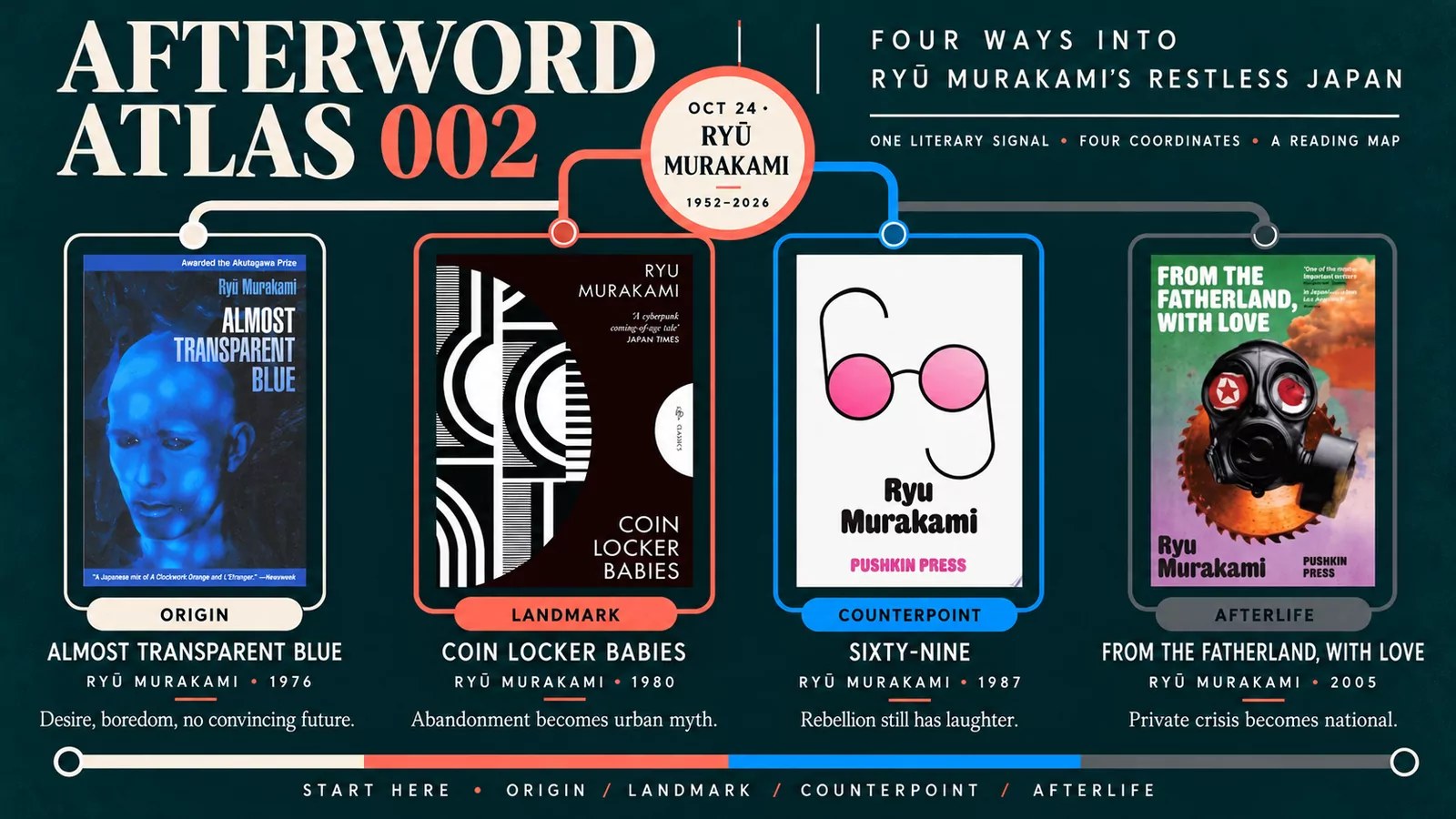
Where to Start with Ryū Murakami: Four Books for a Restless Japan
News of Ryū Murakami's death was announced on October 23, six days after he died at home at the age of 74. The easiest way to remember him would be through a few labels: Japan's enfant terrible, the author of Audition, or "the other Murakami."
None is enough.
Across five decades, Murakami wrote about young people formed by American military presence, consumer desire, boredom, abandonment, popular music, violence and institutions that could no longer explain the lives around them. His books can be brutal, but brutality is not their only subject. They also contain speed, comedy, political anger and a persistent question: what do people build when the society they inherit gives them no convincing future?
This four-book map follows that question from a damaged debut to a national-scale dystopia.
One literary signal. Four coordinates. A reading map.
Why read him today?
A memorial list can flatten a writer into reputation. Murakami is especially vulnerable to that treatment because his most notorious scenes travel more easily than the structures around them.
Read in sequence, these four books show something larger. A private cycle of self-destruction becomes a story of abandoned children and a poisoned city. Youthful rebellion reappears as comedy. Decades later, social failure expands into a political thriller about whether a nation can still act.
The route is not a ranking. Choose the coordinate that matches the scale and intensity you want.
ORIGIN · Almost Transparent Blue (1976)
Read for: the first rupture.
Murakami's debut follows a group of young people near an American military base through drugs, sex, rock music, boredom and sudden violence. Written while he was still a student, it won the Akutagawa Prize and immediately divided readers.
What matters now is not simply that the novel shocked Japan. Its compressed, image-heavy prose refuses to turn damaged youth into a reassuring social lesson. Pleasure and exhaustion blur together; American cultural power is both intimate and alienating; the characters move rapidly while seeming unable to go anywhere.
Begin here if you want to see the source of Murakami's recurring world: bodies under pressure, imported desires and young people living after inherited explanations have lost their force.
Selected English edition: translated by Nancy Andrew, Kodansha International, 2003, ISBN 9784770029041. Availability may be uneven; check libraries and legitimate used-book listings rather than assuming a current retail edition.
Content note: explicit sex, drug use, violence and self-destructive behaviour.
LANDMARK · Coin Locker Babies (1980)
Read for: Murakami at full imaginative scale.
Two babies abandoned in station coin lockers survive, grow up among outsiders and take radically different paths. One becomes a rock star; the other turns his abandonment into an obsession with revenge. Their stories eventually collide with a city that feels part playground, part laboratory and part disaster zone.
This is the map's landmark because so many of Murakami's strengths meet here: pop music, damaged childhood, bodily extremity, urban mutation, black humour and apocalyptic momentum. The novel keeps enlarging its premise without losing the original wound at its centre.
Notice how abandonment becomes more than backstory. It shapes appetite, identity, performance and the characters' ideas of what the city owes them. The book's excess is not decoration; it is the form taken by lives that cannot find an ordinary scale.
If you plan to read only one large Murakami novel, start here.
Selected English edition: translated by Stephen Snyder, Pushkin Press, 2013, 512 pages, ISBN 9781782270348.
Content note: child abandonment, violence, sexual material and disturbing imagery.
COUNTERPOINT · Sixty-Nine (1987)
Read for: rebellion before it becomes ruin.
Set in 1969, this fast, comic coming-of-age novel follows seventeen-year-old Kensuke Yazaki and his friends as they talk about music, movies and revolution, barricade their school and organise a festival—while remaining at least as interested in impressing girls as in changing the world.
Place it beside Almost Transparent Blue. Both are preoccupied with youth and Western culture, but their emotional temperatures are strikingly different. One sees a generation trapped in destructive consumption; the other remembers performance, friendship and political pose as sources of comic energy.
That contrast matters. It prevents Murakami's career from becoming a straight line of nihilism. His young characters can be foolish without being empty, and resistance can be compromised without becoming meaningless.
Choose this coordinate if you want the most welcoming entry point—or if the darker books have made his range seem narrower than it is.
Selected English edition: translated by Ralph McCarthy, Pushkin Press, 2013, 192 pages, ISBN 9781908968463.
AFTERLIFE · From the Fatherland, with Love (2005)
Read for: the private crisis expanded to the scale of a country.
In an alternative near-future, economic collapse leaves Japan vulnerable to an invasion of Fukuoka by North Korean forces. Government institutions falter, and a group of marginalised young people becomes central to the response.
The book is part political thriller, part dystopian satire and deliberately excessive in scale. Its large cast and 672 pages make it a demanding entry point, but a revealing final coordinate. The alienated outsiders of Murakami's earlier fiction have not disappeared; they now occupy a story about bureaucracy, sovereignty and national paralysis.
Read it after Coin Locker Babies and watch the unit of anxiety change. The question is no longer only what abandonment does to two children. It is what collective abandonment looks like when institutions cannot recognise reality quickly enough to act.
Selected English edition: translated by Ralph McCarthy, Charles De Wolf and Ginny Tapley Takemori, Pushkin Press, 2013, 672 pages, ISBN 9781908968494.
Content note: war, political violence and graphic brutality.
Choose your route
- One book only: Coin Locker Babies.
- The gentlest entrance: Sixty-Nine, then Coin Locker Babies.
- The career arc: Almost Transparent Blue → Coin Locker Babies → Sixty-Nine → From the Fatherland, with Love.
- Short, claustrophobic detour: add In the Miso Soup after Sixty-Nine if you want a psychological thriller rather than another epic.
What to notice as you read
Murakami's work is often described through content—sex, drugs, violence, technology—but form is doing equal work. Notice the velocity of a scene, the collision between pop culture and political history, and the moment a private appetite becomes a social diagnosis.
Also notice who is allowed to imagine a future. His characters often inherit institutions that can regulate, punish or consume them but cannot give their lives meaning. Their answers are frequently destructive. The novels remain compelling because they refuse to pretend that destruction is the same thing as freedom.
Read him now not to make the darkness respectable, and not to reduce a long career to shock. Read him to follow how one writer kept changing the scale of the same unrest.
Edition and source notes
- Death announcement and career overview: The Guardian, October 23, 2026
- Almost Transparent Blue: Kodansha America bibliographic record via Google Books
- Coin Locker Babies: Pushkin Press
- Sixty-Nine: Pushkin Press
- From the Fatherland, with Love: Pushkin Press
- Optional detour, In the Miso Soup: Bloomsbury
Edition details and availability checked October 24, 2026. This is an editorial reading route, not a ranking. The accompanying Afterword Atlas image uses the verified selected-edition covers listed above.