Discover Literature Through the Translator, Not Just the Author
A five-step method for following translator credits into legal samples, literary journals, presses and under-read writing across languages.
Discover Literature Through the Translator, Not Just the Author
Readers are taught to follow authors. Translators are often left in the small type—even when they are the people repeatedly finding, advocating for and recreating the books that cross into a language you can read.
That makes the translator's name more than a credit. It can be a discovery path.
The October 23 shortlist for the 2026 Granum Foundation Translation Prize offers five starting points: Ellen Li translating Marvin Victor, Allana Lieberman translating Sabina Urraca, Richard Prins translating Tom Olali, D. P. Snyder translating Ethel Krauze, and Kathleen Sullivan translating Malek Lakhal. The announcement does not prove that every project is published, available, or excellent. It does something more preliminary: it identifies five relationships worth investigating.
The useful habit is not “trust every prize list.” It is:
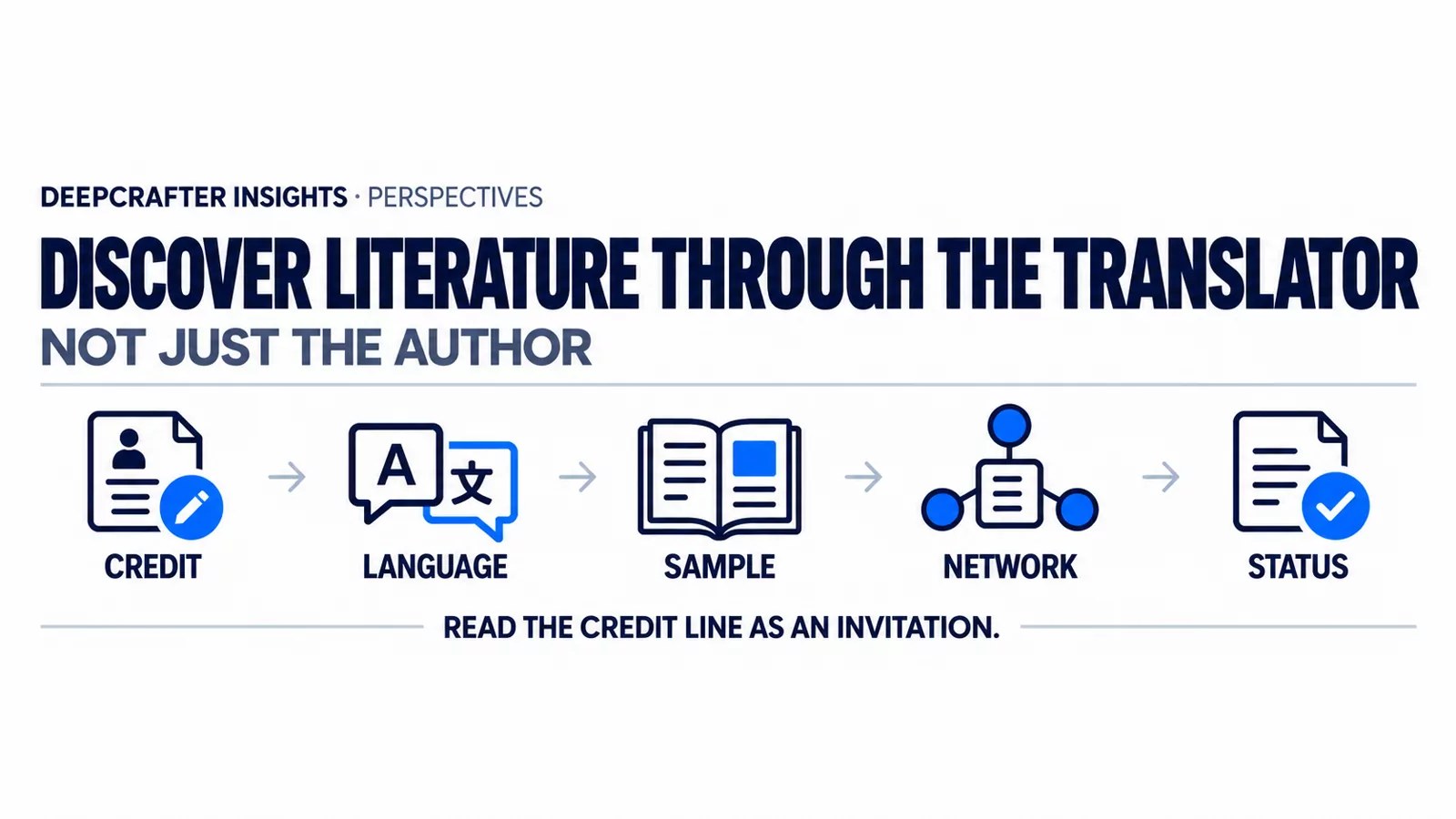
Start with the translator → map the language and recurring interests → find a legal sample → follow the journals and presses → verify the project's status.
Why follow a translator?
A translator's body of work can reveal a line that ordinary recommendation systems miss.
Bookstores usually group by genre, author, sales, or national market. A translator's bibliography may connect experimental fiction, oral tradition, diaspora writing and poetry across different publishers. The connection is not that the books are interchangeable. It is that one reader-writer has repeatedly judged these works worth carrying across languages.
That judgment is not infallible, and translators do not always choose the projects they are hired to complete. But a translator trail gives you better questions:
- Which languages and regions recur?
- Which journals trusted early samples?
- Which authors appear before a book deal exists?
- What formal problems interest this translator?
- Which small presses repeatedly publish the work?
The byline becomes an index.
Route 1: Read the sample before the promise
Richard Prins's trail is a clear example.
The Granum shortlist names his translation of Tom Olali. Before assuming a complete English edition is available, a reader can find a legal excerpt from Olali's The People of Gehenna in Michigan Quarterly Review, translated from Swahili by Prins. The journal describes a work moving through dialogue, metafiction, philosophy, domestic drama and humour. That is enough to encounter the project directly without pretending the whole book is already on sale.
Then follow the translator, not only the title. Prins's Words Without Borders page identifies other Swahili work, including his translation of Euphrase Kezilahabi, and notes forthcoming translations of Muyaka bin Haji al-Ghassaniy and Katama Mkangi.
One sample opens a route: Olali → Prins → Swahili prose and poetry → the journals and presses publishing it.
Route 2: Separate “forthcoming” from “available now”
Allana Lieberman's work with Spanish writer Sabina Urraca shows why status matters.
Lieberman's project page traces her translation work on Urraca and links to magazine appearances. An English-language excerpt is legally readable in The Adroit Journal. A complete English edition, In Heat, is announced by HarperVia for 2027.
Those are three different states:
- Sample available: you can read part of the work now.
- Book announced: a publisher and intended date exist.
- Book published: the edition is actually available.
Literary discovery becomes misleading when these states collapse into one. A prize shortlist may support a work in progress. A magazine publication may be a standalone excerpt. A bookseller page may accept preorders for a future date. Record the state you have verified.
Following Lieberman also gives a more interesting route than waiting for a retail algorithm: from Urraca's Spanish fiction to the magazines that published early English samples, then to the eventual book.
Route 3: Let earlier work establish the translator's range
The Granum announcement names D. P. Snyder translating Mexican writer Ethel Krauze, but it gives no title or publication status. That is a stop sign against invention, not a dead end.
Snyder's existing public work establishes that she translates from Spanish and has published translations and writing in literary venues. A legally available Public Seminar page presents her as a writer and translator from Spanish alongside her translation of Mónica Lavín.
What can you responsibly conclude?
- Snyder's working language includes Spanish.
- The Granum shortlist links her to Krauze.
- Earlier translated work can be sampled legally.
What can you not conclude from the announcement alone?
- the title of the Krauze project;
- whether a complete edition has a publisher;
- whether it can be bought now;
- whether the shortlist predicts its eventual reception.
This distinction protects discovery from turning into fabricated availability.
The five-step translator trail
1. Capture the full credit
Write down the translator exactly as credited, along with the author, source language, work title and publication venue. Do not rely on a social post that omits the translator.
2. Map working languages, not identities
Use the translator's official site, publisher biography, contributor page, or a reputable journal. Do not infer language competence from a surname, birthplace, or the nationality of one author.
3. Find a legal sample
Look for publisher excerpts, established literary journals, translator portfolio pages linking to authorised publications, and institutional archives. A sample lets you experience the prose while respecting access and copyright.
4. Follow the infrastructure
Record the journals, presses, grants and series that recur. Words Without Borders, Michigan Quarterly Review, The Adroit Journal, university presses and translation funds are not interchangeable endorsements. Together, they form a map of where translated literature becomes visible.
5. Label project status
Use plain categories:
- sample published;
- translation in progress;
- forthcoming with publisher and date;
- published edition available;
- status unverified.
“Forthcoming” is not a synonym for “out now.” “Shortlisted” is not a quality guarantee. “Translated by” does not always mean the translator selected the project.
Build a discovery ledger
For each lead, keep one small record:
| Field | What to record |
|---|---|
| Translator | Exact credited name |
| Author and work | Original title if known; English title if authorised |
| Source language | Verified through an official or reputable biography |
| Sample | Legal URL and venue |
| Status | Sample / in progress / forthcoming / published / unverified |
| Next node | Another author, journal, press or grant to follow |
The final field prevents the trail from ending at one book. If a translator repeatedly appears in a journal, browse that journal's translation archive. If a press publishes two of their books, inspect the press's wider list. If a grant supported an unpublished project, follow later announcements without assuming a deal.
What this method changes
Following translators does not replace following authors. It changes the shape of discovery.
Instead of asking only, “What else did this author write?”, you can ask:
- What else did this translator bring into English?
- Which writers are appearing first in journals rather than bookstores?
- Which languages are underrepresented in the lists I already follow?
- Which publishers make room for formally difficult work?
The result is not a guaranteed canon. It is a richer set of doors.
Awards can provide names. Algorithms can provide similarity. Translators can provide a human trail through language, form, advocacy and editorial risk.
Read the credit line as an invitation.
Sources
- Granum Foundation: 2026 Translation Prize shortlist, October 23, 2026
- Michigan Quarterly Review: Tom Olali, “The People of Gehenna,” translated by Richard Prins
- Words Without Borders: Richard Prins contributor page
- Allana Lieberman: current translation projects
- The Adroit Journal: Sabina Urraca, translated by Allana Lieberman
- Public Seminar: D. P. Snyder contributor and translation note
Source and availability status checked October 24, 2026. The Granum shortlist is a discovery signal, not a claim that every project is already published or commercially available.