Must a Character Represent Everyone Like Them?
A three-layer framework for keeping private desire, social position and reader projection distinct when writing identity and representation.
Must a Character Represent Everyone Like Them?
How to separate a character’s private desire, social position and the meanings readers project onto them.
In a conversation published by Literary Hub on October 26, Brandon Taylor discusses the pressure placed on Black art and Black artists in the United States. Speaking about Wyeth, the painter at the center of Minor Black Figures, Taylor asks whether a Black artist is ever allowed to have private aesthetic reasons—or whether every choice is immediately absorbed into a larger cultural argument.
That question belongs to a specific history of race, institutions and interpretation in American art. It should not be flattened into the vague claim that “identity does not matter.” Taylor’s point is closer to the opposite: identity matters so persistently that discourse can stop looking at the actual work and treat the artist as a representative function.
Fiction writers face a related problem. A character’s identity shapes risk, opportunity, memory and how other people read them. Yet the character also wants things that are not reducible to a demographic category. Readers may then ask the character to explain, defend or symbolize a group.
The craft problem is not how to remove representation. It is how to prevent representation from consuming personhood.
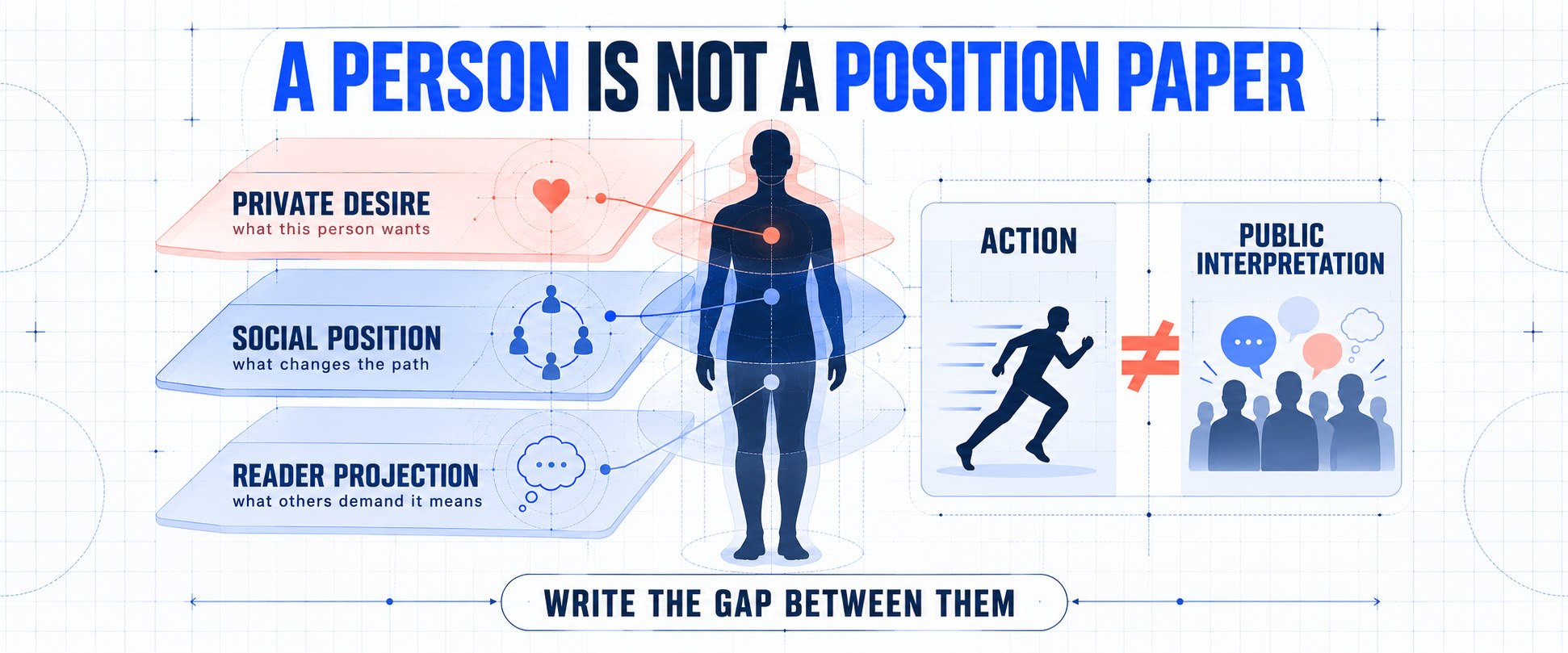
DeepCrafter’s three-layer model separates private desire, social position and reader projection.
Layer one: private desire
Private desire is what this person wants before the story converts them into a topic.
It should be concrete enough to generate choices:
- win the lease on a tiny cinema;
- hide a failed audition from a sister;
- restore a ruined mural before the building is sold;
- keep a parent from discovering an unpaid debt;
- make one beautiful object that nobody can monetize.
“To be accepted” is usually too abstract. Accepted by whom, for what, and at what cost? A desire becomes narratively useful when it can be pursued badly.
Private does not mean apolitical or socially untouched. It means the desire belongs to the character rather than arriving as the author’s assigned lesson. Two people who share an identity can want incompatible things for intelligible reasons.
Layer two: social position
Social position is the set of conditions through which the desire must move. It includes race, gender, class, disability, language, citizenship, family role, geography and institutional power.
This layer should change the path, not merely decorate the biography.
Ask:
- Who has the power to approve, price, publish, hire, police or define this character?
- Which behavior is read differently when this character performs it?
- What history is already present in the room?
- Which risk can another character ignore?
- Where does the character possess power over someone else?
Social position is not a paragraph of explanation. It appears in access, timing, consequence and interpretation.
Layer three: reader projection
Reader projection is the meaning other people demand from the character—inside the story and outside it.
An editor asks the painter to explain what the mural “says about the community.” A wealthy buyer calls the same work “universal” and ignores its location. A childhood friend accuses the painter of selling out. Reviewers disagree about whether a red square signifies danger, anger or merely red.
None of these readings has to be wholly false. The problem begins when a projection is treated as the character’s complete interior truth.
Writers often control projection by making it visible. Let another character misread the protagonist. Let an institution reward the misreading. Let the protagonist exploit, resist or feel ambivalent about it. Representation pressure then becomes dramatic action rather than authorial explanation.
An original two-version example
Consider Leila, a preservation architect trying to save a neighborhood cinema.
Version A: the spokesperson
Leila wants to save the cinema because it represents her community’s resilience. In every scene, she explains displacement, heritage and belonging. Other characters ask questions so she can deliver correct answers. Her private life pauses whenever the theme enters.
This version may contain accurate statements, but Leila functions as a position paper.
Version B: the person under representation pressure
Leila wants the cinema because her first, disastrous student design is hidden beneath its later renovation. Saving the building will also preserve evidence of the mistake she has spent fifteen years denying. Her neighborhood association sees her as its expert advocate. A developer assumes she can be won with professional prestige. Her brother wants the building demolished because their father lost money there.
Now identity and history still matter. They shape who trusts her, who can afford delay, who is heard at the planning meeting and why the cinema carries communal weight. But Leila’s motive is not a clean emblem. She can protect public memory and conceal private shame in the same action.
The contradiction does not make her less representative. It makes representation incomplete.
Give the character an excess
A convincing character usually contains something the thematic frame cannot use up.
That excess might be:
- an aesthetic preference with no approved explanation;
- a petty rivalry;
- a private superstition;
- an inconvenient pleasure;
- a talent unrelated to the plot’s public conflict;
- a wrong opinion held for a persuasive emotional reason.
Excess prevents the character from becoming the sum of externally legible traits. It also creates surprise without randomness: the reader discovers that the person has priorities the discourse did not predict.
Avoid the opposite mistake: “universal” as erasure
Some writers react to tokenism by insisting that a character is “just human.” That phrase can hide the default assumptions built into the fictional world.
If every character can pursue desire under identical conditions, social position has disappeared from causality. The result is not freedom from stereotype; it is a world in which power leaves no trace.
The three-layer model therefore keeps all three questions active:
- What does this person want?
- What conditions shape the pursuit?
- What meanings do others impose on the pursuit?
Removing any layer makes the character thinner.
Scene design: create a projection gap
Build a scene in which the character’s action and the public interpretation diverge.
- Give the character a private goal.
- Place them in an institution that has a preferred story about people like them.
- Make the character choose an action that can be read two ways.
- Let another person reward or punish the projected meaning.
- End with the character deciding whether to correct the interpretation.
The decision not to correct can be as revealing as resistance. A character may accept a useful misreading, resent it and still need what it provides.
The dialogue audit
Search the draft for every moment the character explains identity or community. For each speech, ask:
- Would this person say this to this listener?
- Is the listener capable of changing the situation?
- Does the speech cost the speaker anything?
- Is the information already known by both characters?
- Is the scene moving, or has the novel paused to brief the reader?
If the speech exists only because the author fears being misunderstood, move the information into consequence, conflict or specific detail.
The comparison audit
Create two characters who share one salient identity but differ in at least three of the following:
- class position;
- generation;
- professional power;
- relationship to the community;
- aesthetic preference;
- appetite for visibility;
- interpretation of the same historical event.
Do not make one “authentic” and the other “assimilated.” Give each a coherent private desire and something to lose. Difference within a group is not a rebuttal to social context; it is evidence that context acts on people rather than replacing them.
What the Taylor conversation clarifies
Taylor’s remarks are not a universal law for every identity or every art form. They emerge from the specific double discourse around Black contemporary art in the United States. But they sharpen a widely useful warning for fiction: interpretation can become reductive even when it sounds affirming.
A character may be praised as inspiring, authentic or important and still be denied aesthetic motive, bad judgment, privacy or contradiction. Positive flattening is still flattening.
The writer’s task is therefore not to decide whether the character represents. Readers will make connections, institutions will classify and stories participate in cultural histories. The task is to build a person whose life exceeds any single use.
A compact planning card
Before drafting a major scene, write three lines:
- Private desire: What does the character want here that they would not put in a public statement?
- Social position: Which constraint or advantage changes how they can pursue it?
- Reader projection: What larger meaning will another person assign to the action?
Then write the gap between those lines.
A character does not become more human by escaping history. They become more human when history, desire and interpretation remain present without collapsing into one another.