Translate the Idiom, Keep the Character
Preserve what a character is doing socially when an idiom crosses languages: teasing, demanding honesty, accusing, or inviting a reply.
Translate the Idiom, Keep the Character
A translated line can preserve every body part and lose the character's intention. Was that teasing, a demand for honesty, or an accusation?
1. Identify what the speaker is doing
Milo claims a singing dog performed at the bakery. In the Spanish original, Rosa answers with an idiom about taking someone's hair.
In this scene she is teasing him, not reporting physical contact.
2. Replace the literal image when it misleads
"You're taking my hair" points an English reader toward hair.
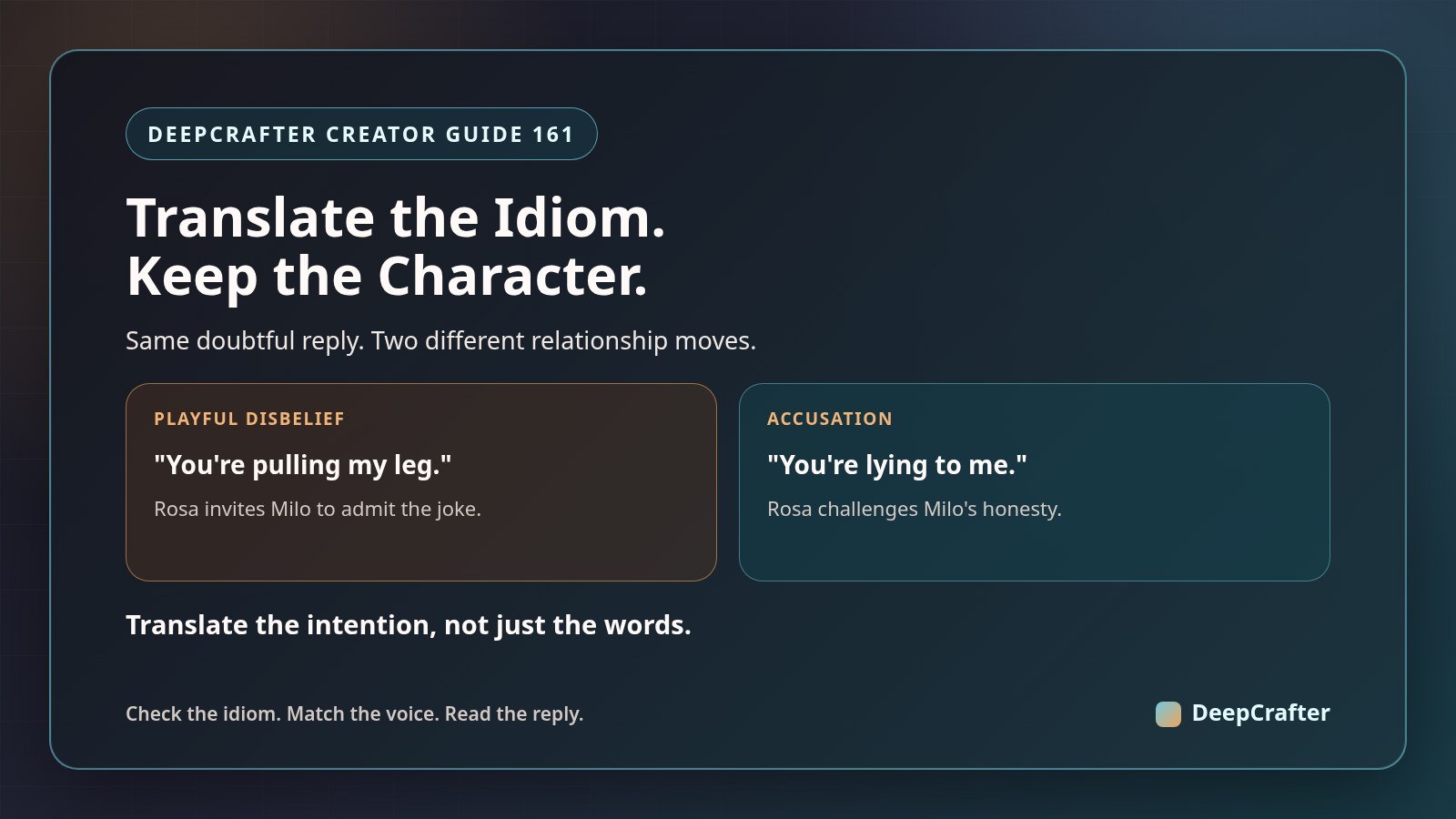
"You're pulling my leg" can convey playful disbelief instead. The body part changes; Rosa's response to Milo's unlikely claim survives.
3. Compare intention, not just dictionary meaning
- "You're pulling my leg." Playful disbelief.
- "Tell me the truth." A demand.
- "You're lying to me." An accusation.
All question his story. They do not put the same pressure on the relationship.
4. Match the speaker's register
Would Rosa say "You're pulling my leg," "You're kidding," or something more formal?
Choose the line that fits her age, habits, and relationship with Milo. A natural idiom can still be wrong for this character.
5. Use DeepCrafter's Translate to create another-language version
Then review idioms in context. For Rosa's English line, compare what she intends with what the translation makes her sound like she intends. Fluency alone is not the test.
6. Check whether the original image matters elsewhere
If hair is part of a literal joke or a recurring image, replacing it may break a later line. Rework the linked passage, not just the idiom.
Do not preserve every image, but account for what you change.
7. Read the reply as a translation check
Milo grins and admits the dog only barked. Does Rosa's English line make that response feel natural?
If it makes her sound furious, his grin may seem cruel. Review the exchange, not one sentence.