No One Is Late to the Writing Life: Ten Authors Who Began Again
From jazz clubs and hospitals to civil service and science labs, ten acclaimed authors show that a writing career can begin in the middle of another life.
No One Is Late to the Writing Life: Ten Authors Who Began Again
There is no single age at which a writer is supposed to begin.
Some people arrive through literature degrees and early publications. Others come through jazz clubs, hospitals, laboratories, government offices, classrooms, newspapers, repair shops and years of work that seemed to have nothing to do with fiction. Then a sentence opens. A story insists. A second career begins inside the first life.
For a new writer, this matters. The years before writing are not empty years. They may have already given you the rhythms of a workplace, the vocabulary of a profession, the pressure of responsibility, the memory of people under strain and the discipline to return to difficult work.
Here are ten writers whose paths into professional authorship did not follow a straight line.
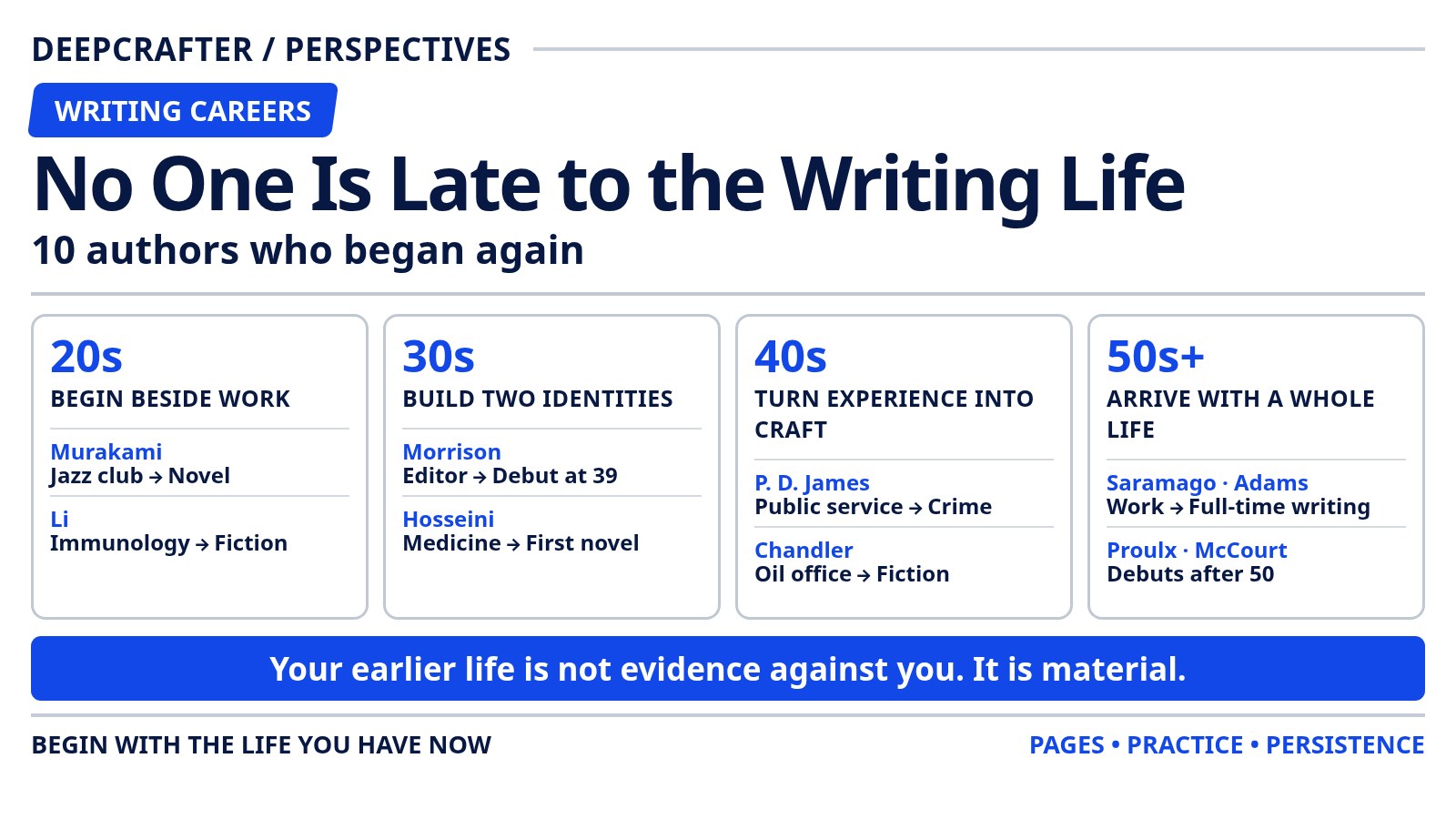
1. Haruki Murakami: from jazz-club owner to novelist at twenty-nine
In his twenties, Haruki Murakami ran a jazz club in Tokyo. He has described working from morning until late at night to pay off debt. At twenty-nine, while watching a baseball game, he suddenly felt that he could write a novel. He began drafting after work, at a small kitchen table, and his first novel, Hear the Wind Sing, appeared in 1979. The Paris Review describes how the club supported him until publication made a writing life possible; his official Japanese publisher chronology marks the turn at age twenty-nine.
The club was not a detour from the work. Music shaped his sense of rhythm, repetition and improvisation. The practical lesson is not to wait for a perfectly literary life. Begin with the life you have, and let its rhythms enter the page.
2. Toni Morrison: editor, teacher, mother—and debut novelist at thirty-nine
Toni Morrison taught at universities and became a senior editor at Random House. Her first novel, The Bluest Eye, was published in 1970, when she was thirty-nine. The Toni Morrison Society chronology places her senior editorial work before the novel; the Nobel Prize biography records both her editorial career and her 1970 fiction debut.
Morrison did not need to stop being an editor before she could become a novelist. She wrote within a life already full of books, work and family. Her path is a reminder that a professional identity can overlap with another one for years. You do not have to announce a total reinvention before you have written the pages.
3. Yiyun Li: from immunology to fiction in a second language
Yiyun Li moved from China to the United States in 1996 to pursue graduate study in immunology at the University of Iowa. She later shifted to the Iowa Writers’ Workshop and devoted herself to fiction in English, her adopted language. The MacArthur Foundation biography records that change directly.
This was more than a change of profession. It was a change of intellectual field and literary language. Li’s route shows that what appears to be a late turn may also be the moment when previous knowledge, distance and a new language begin working together. A writer can start again without discarding the mind that earlier work developed.
4. Khaled Hosseini: writing a first novel while practicing medicine
Khaled Hosseini was a physician when he began writing The Kite Runner in March 2001. The novel was published in 2003. His official biography makes the overlap clear: medicine was not a childhood chapter that ended before writing began; it was the career he was practicing when the novel took shape.
Hosseini’s example offers a useful correction to the fantasy that a serious book requires an empty calendar. A novel can begin before life makes room for it. The first professional move may be protecting a few repeatable hours, not immediately leaving the job that pays the bills.
5. P. D. James: public service by day, crime fiction across five decades
P. D. James worked in Britain’s National Health Service and then the Home Office for more than thirty years. Her first novel, Cover Her Face, appeared in 1962, when she was forty-two. Her official estate biography notes that she drew on her institutional experience in her novels.
She did not merely survive a non-literary career until writing rescued her. She turned close knowledge of hospitals, laboratories, police departments and public systems into atmosphere and authority. The workplace you know too well may contain the details another writer could never invent.
6. Raymond Chandler: fired at forty-four, first novel at fifty
Raymond Chandler rose through an oil company before losing his job during the Great Depression at forty-four. He turned seriously to crime fiction, published his first story in Black Mask in 1933 and released The Big Sleep in 1939, when he was fifty. The Chicago Public Library biography traces that difficult reinvention.
Chandler’s turn was not romantic. It followed failure, economic pressure and years of learning the craft through short stories. Reinvention often looks less like a revelation than an apprenticeship undertaken when the old plan has collapsed. A late beginning can still include deliberate practice.
7. José Saramago: mechanic, civil servant, editor, journalist, then full-time literature
José Saramago trained as a mechanic because his family could not afford to keep him in grammar school. He worked in a repair shop, public administration, publishing and newspapers. After losing his newspaper position in 1975, in his early fifties, he decided to devote himself to literature. His own Nobel Prize autobiography tells the sequence.
Saramago had published earlier, but his defining writing life emerged after decades of other work and a long absence from the literary scene. He did not become younger when he committed himself to literature; he became more fully himself. The accumulated life was not an obstacle to the voice. It was part of the voice.
8. Richard Adams: civil servant, rejected manuscript, first novel at fifty-two
Richard Adams joined the British civil service in 1948. He completed Watership Down in the mid-1960s, struggled for years to find a publisher and saw it published in 1972, when he was fifty-two. His publisher biography records the civil-service career and the difficult publication path.
The novel began in stories told to his daughters. That origin matters: the work did not begin as a strategic attempt to enter the market. It began as repeated storytelling, then became a manuscript, then survived rejection. A private practice can become public work—but only if you keep carrying it forward.
9. Annie Proulx: practical manuals and local journalism before fiction
Before her literary debut, Annie Proulx wrote nonfiction, practical manuals about rural life and a local newspaper. Her first story collection appeared in 1988; her first novel, Postcards, followed when she was fifty-six. The National Book Foundation biography describes the path from graduate study to nonfiction work, local publishing and fiction.
Proulx’s earlier writing was not glamorous, but it trained observation, research and exact language. Professional writing is often built through forms that do not yet look like the book you hope to publish. Every clear sentence can be part of the apprenticeship.
10. Frank McCourt: twenty-seven years in classrooms, first book at sixty-six
Frank McCourt taught in New York City schools for twenty-seven years. He was retired when Angela’s Ashes, his first book, appeared at age sixty-six. It won the Pulitzer Prize for Biography. The Academy of Achievement biography records both the long teaching career and the late debut; the Pulitzer Prize page confirms his years as a writing teacher.
McCourt’s classrooms were not time stolen from writing. They were places where he learned voice, audience, timing and the difference between a story that is merely remembered and one that can hold a room. Starting late did not mean arriving empty-handed.
What these careers have in common
The ten paths are different, but several patterns repeat.
They did not wait for permission to use their earlier lives
Music, medicine, science, editing, government, journalism and teaching all entered the writers’ later work as rhythm, knowledge, setting or discipline. You do not need to erase your previous career to sound literary. Specific experience is one of the things that can make your writing yours.
The transition was usually gradual
Several wrote while still employed. Others moved through stories, journalism or practical nonfiction before a novel. “Become a writer” was not one dramatic day; it was a series of completed pages, submissions, publications and choices.
A first book was rarely the first act of writing
The visible debut can hide years of reading, drafting, revising and learning. Do not compare your private beginning with another writer’s public arrival.
Age added material as well as difficulty
Later writers may have less free time, but they often possess a deeper store of work, relationships, failure, place and moral conflict. The goal is not to pretend age changes nothing. It is to use what age has already given you.
A practical way to begin again
If you want a professional writing life, do not begin with the resignation letter. Begin with a season of work.
1. Choose one form for the next twelve weeks
Pick a short story, a novel chapter sequence, a memoir essay or another form you can finish. A career is too large to practice; a form is not.
2. Protect a repeatable appointment
Three reliable sessions a week are more valuable than an imaginary future month of freedom. Make the time visible on the calendar and small enough to survive a difficult week.
3. Borrow detail from your real expertise
List ten things your profession, family history, language, region or former work taught you that an outsider would likely miss. Use one detail to create pressure in a scene, not merely decoration.
4. Build three professional habits
Keep:
- a pages file, where the work itself grows;
- a craft notebook, where reading becomes a lesson;
- a submission or completion log, where private effort becomes an outward practice.
5. Define the next threshold, not the final identity
Your next threshold might be finishing 20,000 words, revising one story, joining a serious workshop or sending five submissions. Reach it, then choose the next one. “Professional” begins as a way of treating the work before it becomes a job title.
Your earlier life is not evidence against you
You may have spent twenty years in an office, a clinic, a shop, a classroom, a lab or a home. You may be writing in a language you learned later. You may have abandoned one manuscript and returned with another. None of that disqualifies you.
The writers above did not all take the same risk, achieve success at the same speed or become full-time authors in the same way. What they share is simpler: they kept moving from lived experience toward finished work.
You do not need to catch up with the writer you might have been at twenty-two.
You need to write the next page with the life you have now.
Sources
- Haruki Murakami — The Paris Review
- Toni Morrison — Nobel Prize biography
- Yiyun Li — MacArthur Foundation
- Khaled Hosseini — official biography
- P. D. James — official biography
- Raymond Chandler — Chicago Public Library
- José Saramago — Nobel Prize autobiography
- Richard Adams — Simon & Schuster
- Annie Proulx — National Book Foundation
- Frank McCourt — Academy of Achievement