An Imagined Act Is Not an Event
A seven-step guide to separating a character's imagined action from what physically happens in the scene.
An Imagined Act Is Not an Event
A character can imagine a dramatic act without performing it. Readers need to know which world the verbs belong to. Frame the possibility before it unfolds.
1. Anchor the actual scene first
Ivo sits at an auction, holding a bidding paddle while his father's portrait is offered for sale.
Before entering his imagined response, give readers a stable position to return to. The paddle is still in his hand.
2. Mark the imagined act at its entrance
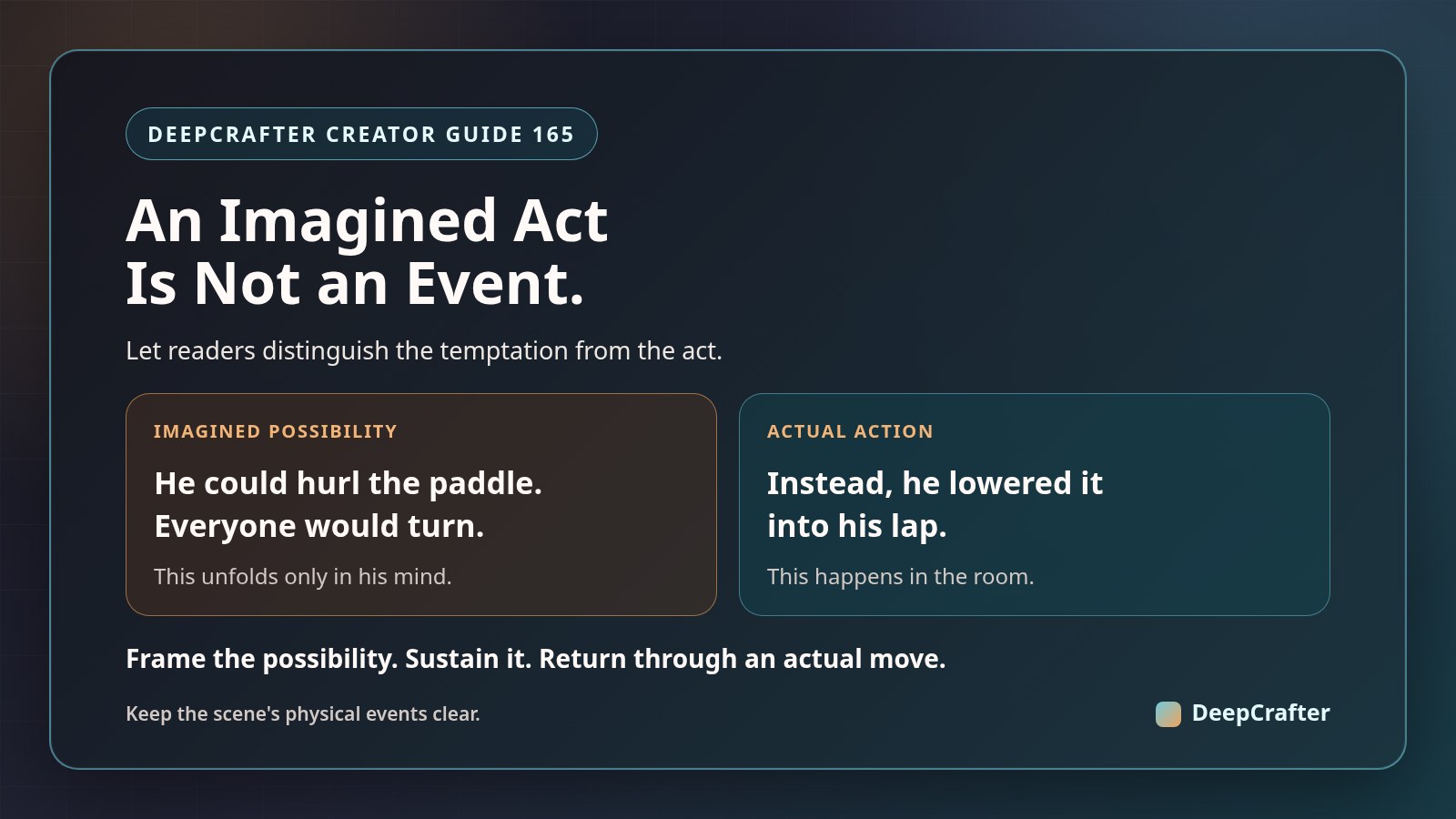
He could hurl the paddle at the auctioneer's desk.
Could opens a possibility here. "He hurled the paddle" presents an event instead. A later "he imagined" may arrive after readers have already pictured it as real.
3. Keep the consequences inside that possibility
It would strike the polished wood. Everyone would turn. For once, they would have to listen.
The repeated would sustains this imagined sequence. You need not attach "he imagined" to every sentence.
4. Do not let the actual room react to an unperformed act
If Ivo only imagines throwing the paddle, the auctioneer cannot flinch at its impact.
A reaction needs an actual cue: perhaps Ivo raises his arm. Decide whether that movement really happens.
5. Return through a literal action
Instead, he lowered the paddle into his lap.
The imagined disruption gives way to something he actually does. The portrait remains for sale. His urge has shown us what restraint costs without interrupting the auction.
6. Ask DeepCrafter's sidebar Chat to separate the two inventories
Ask:
Which actions does this excerpt establish as actual, and which as imagined? Quote the wording that separates them.
Check the answer against your intention. Revise the framing where the two inventories disagree.
7. Read only the actual actions
Ivo holds the paddle, then lowers it.
Does the room remain consistent? Restore the imagined passage. Does it reveal something worth the detour?
Keep any blur deliberate, not accidental.