Combine Roles, Not Opposing Wills
A seven-step method for combining minor characters without inventing impossible access, breaking motives or erasing the disagreement that powers a scene.
Combine Roles, Not Opposing Wills
A short story can spend more time introducing helpers than developing its conflict. Two minor characters can sometimes become one—but only when the merge preserves access, motive and every disagreement the story still needs.
1. List jobs before names
A traveling glassmaker meets a messenger who brings a seizure notice, a host who offers shelter and an examiner who claims the glass.
Before deciding who can be combined, mark what each person contributes:
- information;
- practical help;
- resistance.
The task is not to erase a name. It is to reorganize story functions without weakening the scene.
2. Try the compatible pair first
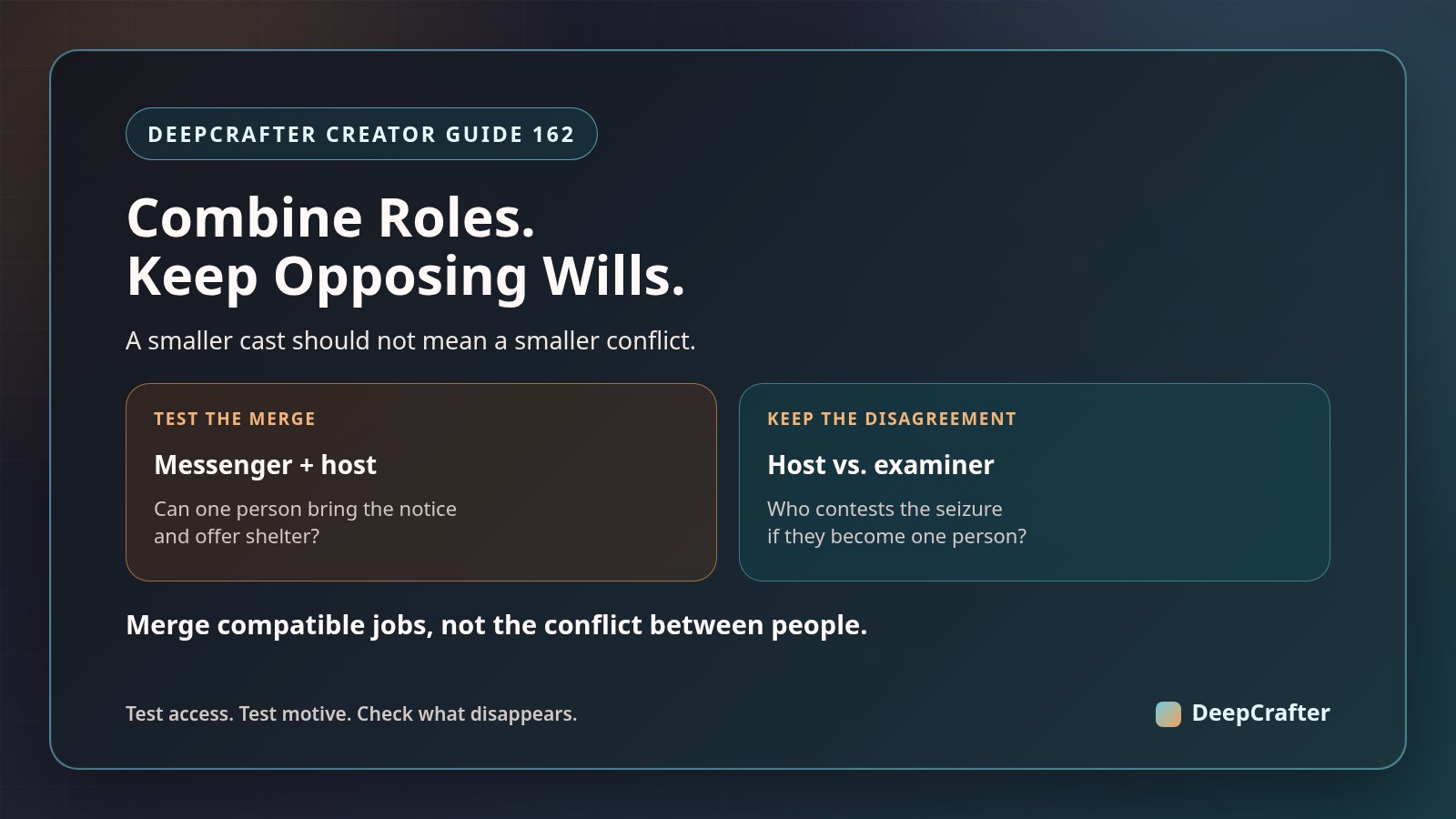
Could the host bring the notice as well as offer shelter?
Perhaps the notice was delivered to her house, where the glassmaker is staying. One arrival now supplies both news and refuge. The combination has a reason inside the story, not only a desire to shorten the cast list.
3. Check access before accepting the merge
Was the notice actually sent to the host's address? Is she present when it arrives? Would she pass it on?
If the new role requires unexplained knowledge, convenient travel or a sudden change of loyalty, the smaller cast has created a larger repair.
4. Preserve the opposing will
The host challenges the examiner's seizure. Making them one person removes that confrontation.
An official could regret enforcing a rule, but that creates a different scene: conflict moves inside one character instead of remaining between two. Choose that transformation deliberately. Do not call a lost disagreement a trim.
5. Compare the merge before changing the manuscript
In DeepCrafter's sidebar Chat, ask:
Could the host also deliver the notice? Test access, motive, and any disagreement lost by combining roles.
Use the discussion to compare options before changing the manuscript. You decide which people the story needs.
6. Follow the merged character through every affected scene
Can the host still hide the glassmaker without contradicting her earlier actions? Who witnesses the seizure now?
Revise entrances, knowledge and loyalties together. Replacing a name is not the whole edit.
7. Compare what the reader gains and loses
Did the merge remove an introduction while making the host's involvement richer? Or did it erase a useful independent response?
Keep the smaller cast only when it serves the story. Fewer people is not the goal by itself.
Completion check
The merge is ready only when:
- the combined character has believable access to every needed fact;
- their motives remain coherent across all affected scenes;
- no necessary opposition disappears by accident;
- entrances, witnesses and loyalties have been revised together;
- the reader gains clarity or depth, not merely one fewer name.